2026-05-13 東京大学
<関連情報>
- https://www.h.u-tokyo.ac.jp/press/20260513-2.html
- https://www.h.u-tokyo.ac.jp/press/__icsFiles/afieldfile/2026/05/13/release_20260513.pdf
- https://www.nature.com/articles/s41598-026-47311-1
急性血便における小腸出血の特異な臨床経過と不良な転帰:全国多施設共同研究 Distinct clinical course and poor outcomes of small bowel bleeding in acute hematochezia: a nationwide multicenter study
Yuga Komaki,Naoyuki Tominaga,Atsuo Yamada,Eiji Sadashima,Katsumasa Kobayashi,Atsushi Yamauchi,Jun Omori,Takashi Ikeya,Taiki Aoyama,Yoshinori Sato,Takaaki Kishino,Naoki Ishii,Tsunaki Sawada,Masaki Murata,Akinari Takao,Kazuhiro Mizukami,Ken Kinjo,Shunji Fujimori,Takahiro Uotani,Minoru Fujita,Hiroki Sato,Sho Suzuki,Toshiaki Narasaka,Junnosuke Hayasaka,… Naoyoshi Nagata
Scientific Reports Published:13 May 2026
DOI:https://doi.org/10.1038/s41598-026-47311-1
Abstract
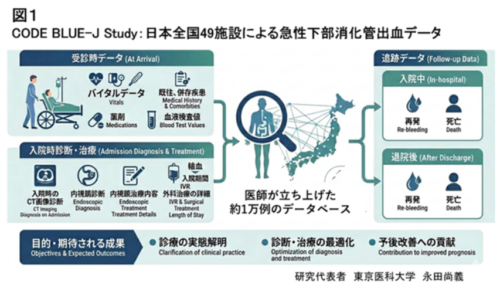
Although small bowel bleeding is a known cause of acute lower gastrointestinal bleeding (ALGIB), its outcomes compared to colorectal bleeding remain underexplored. This study aimed to identify baseline characteristics and short- and long-term outcomes associated with small bowel bleeding in comparison to colorectal bleeding. This nationwide retrospective cohort study, based on CODE BLUE-J study, involved 10,342 patients hospitalized for ALGIB. Among 195 patients (2.8%) with acute small bowel bleeding, significant associations were observed with laboratory parameters (e.g., low hemoglobin, platelets, and albumin), clinical signs (e.g., tarry stool), and medical history, compared to 6832 patients with colorectal bleeding. Multivariate regression analysis showed no significant difference in 30-day rebleeding or mortality between small bowel and colorectal bleeding. However, small bowel bleeding was associated with higher transfusion volume, lower endoscopic treatment rate, higher rates of interventional radiology and surgery, and longer hospital stay (all p < 0.005). While long-term cumulative rebleeding rates were similar, cumulative mortality was significantly higher in the small bowel bleeding group (p < 0.001). This large-scale endoscopic study revealed differences in several clinical factors at presentation and in short- and long-term outcomes between small bowel and colorectal bleeding. These findings underscore importance of identifying small bowel bleeding in ALGIB.