2026-06-03 沖縄科学技術大学院大学(OIST)
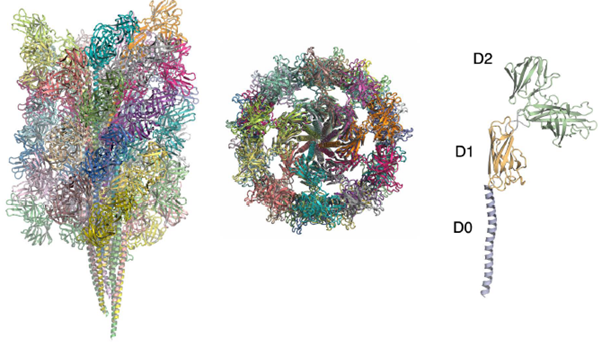
研究チームはクライオ電子顕微鏡を用いて、異なる遺伝子によってコードされる2種類のフィラメント(ArlA2およびArlBと呼ばれるタンパク質からなる)を特定した。 こちらの画像はArlBフィラメントを示しており、右側にはモノマーが三つの領域に分かれた様子が描かれている。D2領域は外鞘を形成し(中央の画像で確認できる外側の輪)、隣接するモノマーとの強い相互作用によって、より強い構造を生み出している。この構造は、高塩濃度で粘性のある水中での運動に適している。© Meshcheryakov et al., Nature Comms, 2026. DOI: 10.1038/s41467-026-72670-8. Copyright CC-BY-ND-4.0.
<関連情報>
- https://www.oist.jp/ja/news-center/news/2026/6/3/extreme-adaptation-helps-dead-sea-single-celled-organisms-swim
- https://www.nature.com/articles/s41467-026-72670-8
Haloarcula marismortuiの鞘状アーケラム構造の 2 種類は、外層構造が異なる Two types of sheathed archaellum structures from Haloarcula marismortui differ in their outer layer architectures
Vladimir A. Meshcheryakov,Jaekyung Hyun,Satoshi Shibata,Alexey S. Syutkin,Mikhail G. Pyatibratov & Matthias Wolf
Nature Communications Published:06 May 2026
DOI:https://doi.org/10.1038/s41467-026-72670-8 Unedited version
Abstract
Many archaea swim by means of rotating helical filaments called archaella. Most archaella are about 10 nm in diameter and comprise multiple copies of the protein archaellin. Here, we describe two archaellum structures formed by the ArlA2 or ArlB archaellins from the haloarchaeon Haloarcula marismortui. We found that both filaments have an additional proteinaceous outer sheath surrounding their inner core, a feature not observed previously in archaea. The outer sheath structures of the two filaments differ fundamentally. The outer domain of ArlB archaellin rotates by 180°, forming stable dimers that likely increase the filament rigidity. In contrast, neither rotation nor dimerization of the outer domain was observed in ArlA2 filaments. 3D variability analysis demonstrated that the motions of ArlA2 and ArlB filaments are significantly distinct. Additionally, the ArlB filament displays a larger negatively charged surface area than ArlA2, which may help adaptation to higher salt concentrations. Our structural findings provide insight into how the two filaments can adapt to their different environments. Larger archaellins with additional outer domains can be found in various groups of archaea. We propose that such proteins may allow hosts to modify the properties of their archaella to enhance environmental adaptation.