2026-06-03 東北大学
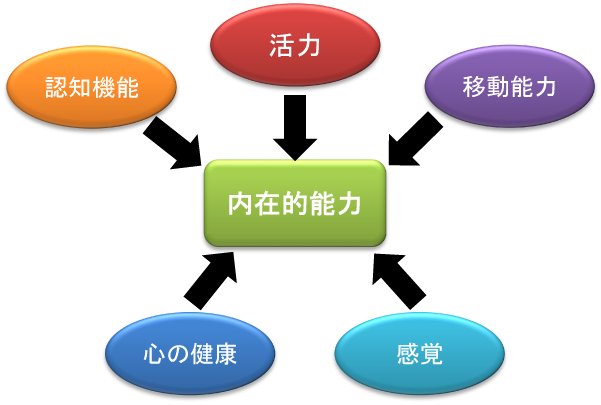
図1. 内在的能力(Intrinsic capacity)を構成する5領域
<関連情報>
- https://www.tohoku.ac.jp/japanese/2026/06/press20260603-02-oralfrailty.html
- https://www.sciencedirect.com/science/article/pii/S1279770726001120
地域在住高齢者の口腔衛生、食事の多様性、在宅状況、および内在能力 Oral health, dietary variety, homebound status, and intrinsic capacity among community-dwelling older adults
Takamasa Komiyama, Takashi Ohi, Eiko Sato, Moe Sato, Yoshinori Hattori
The Journal of nutrition, health and aging Available online: 19 May 2026
DOI:https://doi.org/10.1016/j.jnha.2026.100880
Abstract
Purpose
This study aimed to examine the association between oral health indicators and intrinsic capacity among community-dwelling older adults, and to determine whether dietary variety or homebound status moderated this association.
Methods
The study included 692 community-dwelling Japanese older adults. Oral health indicators included mastication, oral motor function, salivation, swallowing, oral frailty (integrating these four components) based on the latest international e-Delphi study and tongue pressure. All indicators were assessed using oral examinations or validated questionnaires. Intrinsic capacity deficits were assessed across five domains: vitality, psychological, cognitive, locomotive, and sensory. Intrinsic capacity was operationalized as the number of deficits across the five domains. Data on dietary variety and homebound status were also collected. The covariates included age, sex, education, smoking status, drinking status, and comorbidities. Modified Poisson regression models were used to estimate rate ratios (RRs) and 95% confidence intervals (CIs) for the associations between oral health indicators and intrinsic capacity deficits. Interaction terms between oral frailty and dietary variety or homebound status were also included.
Results
The prevalence of sensory, locomotive, psychological, cognitive, and vitality deficits was 41.2%, 7.4%, 11.9%, 22.0%, and 17.3%, respectively. In the multivariate model, individuals having more oral frailty deficits (RR, 1.16; 95% CI, 1.08–1.24), decreased tongue pressure (RR, 1.20, 95% CI, 1.04–1.39), lower oral motor function (RR, 1.22; 95% CI, 1.05–1.42), declined swallowing function (RR, 1.25; 95% CI, 1.08–1.46), and oral dryness (RR, 1.32; 95% CI, 1.15–1.53) were more likely to have intrinsic capacity deficits. No significant interactions were observed between oral frailty and dietary variety, or between oral frailty and homebound status, on intrinsic capacity.
Conclusion
This study showed that cumulative declines in oral health were associated with intrinsic capacity deficits in community-dwelling older adults; moreover, effect modification by dietary variety or homebound status was not identified. Integrated dental services may help maintain intrinsic capacity in older adults; however, longitudinal studies are warranted to better understand this association.