2026-06-02 国立循環器病研究センター
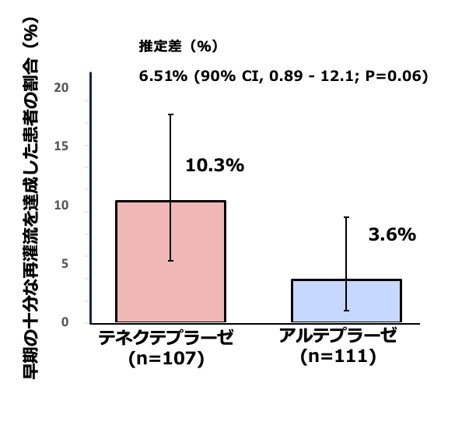
【図1】 血管内治療開始時点での早期再開通率(主要評価項目)
<関連情報>
- https://www.ncvc.go.jp/pr/release/pr_52689/
- https://jamanetwork.com/journals/jamaneurology/fullarticle/2849793
大血管閉塞による急性虚血性脳卒中に対する標準用量テネクテプラーゼと低用量アルテプラーゼの比較 無作為化臨床試験 Standard-Dose Tenecteplase vs Low-Dose Alteplase for Acute Ischemic Stroke From Large-Vessel Occlusion A Randomized Clinical Trial
Manabu Inoue, MD; Teruyuki Hirano, MD; Mayumi Fukuda-Doi, MD:et al
JAMA Neurology Published:June 1, 2026
DOI:10.1001/jamaneurol.2026.1590
Key Points
Question Is standard-dose tenecteplase (0.25 mg/kg) more effective and similarly safe as compared with low-dose alteplase (0.6 mg/kg) for patients with stroke?
Findings In this investigator-initiated, multicenter, randomized clinical trial of stroke with large-vessel-occlusion, tenecteplase (0.25 mg/kg) demonstrated superior substantial reperfusion on the initial angiography to alteplase (0.6 mg/kg), with no significant difference in symptomatic intracranial hemorrhage within 24 to 36 hours or 90-day mortality.
Meaning In this randomized clinical trial, pretreatment with standard-dose tenecteplase before thrombectomy was more effective in terms of early recanalization and showed a comparable safety profile to low-dose alteplase.
Abstract
Importance Tenecteplase has advantages over standard-dose alteplase for acute ischemic stroke. A low-dose alteplase regimen (0.6 mg/kg) remains the standard in Japan and is commonly used in several Asian countries.
Objective To determine whether standard-dose tenecteplase at 0.25 mg/kg achieves a higher rate of recanalization on the initial angiogram than low-dose alteplase at 0.6 mg/kg in patients scheduled for mechanical thrombectomy. It is inevitable to generate evidence required to support potential regulatory approval of tenecteplase in Japan.
Design, Setting, and Participants This investigator-initiated, multicenter, randomized, controlled, open-label, superiority trial was conducted from August 19, 2022, through March 13, 2025, with 3-month follow-up and was the first ever to compare tenecteplase (0.25 mg/kg) with alteplase (0.6 mg/kg) for acute ischemic stroke. Participants included patients with large-vessel-occlusion stroke eligible for intravenous thrombolysis within 4.5 hours of symptom onset followed by mechanical thrombectomy. A total of 221 patients were randomized and 218 who received trial drugs were included in the full analysis set (107 tenecteplase; 111 alteplase). These data were analyzed from July 2025 to December 2025.
Interventions Patients were randomly assigned in a 1:1 ratio to receive either intravenous tenecteplase or alteplase.
Main outcomes and measures The primary outcome was substantial reperfusion (modified Treatment in Cerebral Ischemia grade 2b to 3 or no retrievable thrombus) on the initial angiogram. Secondary outcomes included the 90-day modified Rankin Scale. Safety outcomes were symptomatic intracranial hemorrhage within 24 to 36 hours and mortality at 90 days.
Results A total of 218 patients (mean [SD] age, 77.1 [12.0] years; 92 female and 126 male) who received trial drugs were included in the full analysis set (107 tenecteplase; 111 alteplase). Substantial reperfusion occurred in 10.3% of the standard-dose tenecteplase group vs 3.6% of the low-dose alteplase group (absolute difference, 6.5 percentage points; 90% CI, 0.89-12.1), meeting the prespecified success criterion. The estimated common odds ratio for a shift toward better 90-day functional outcome with tenecteplase was 1.47 (95% CI, 0.92-2.35). Rates of symptomatic intracranial hemorrhage (2.8% vs 1.8%) and mortality (6.5% vs 9.9%) were similar between tenecteplase and alteplase groups.
Conclusions and relevance In this study, standard-dose tenecteplase (0.25 mg/kg) prior to thrombectomy resulted in a higher rate of early substantial reperfusion compared with low-dose alteplase (0.6 mg/kg), with comparable functional and safety outcomes. Standard-dose tenecteplase is a promising thrombolytic option in regions where low-dose alteplase is currently the standard of care.
Trial Registration Japan Registry of Clinical Trials Identifier: 051210055