2026-05-14 東北大学
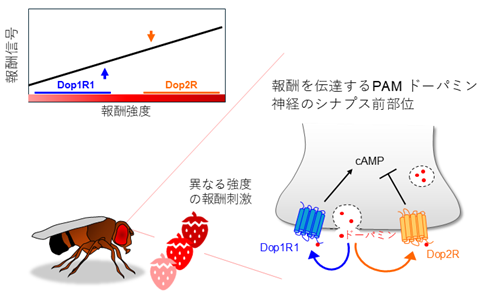
図1. 脳が報酬の強さを見分ける仕組み
ショウジョウバエの報酬神経では、Dop1R1が弱い報酬への感度を高め、Dop2Rが強い報酬への過剰な応答を抑える。2つの受容体の働き分けによって、脳は報酬の強さを読み分けていると考えられる。
<関連情報>
- https://www.tohoku.ac.jp/japanese/2026/05/press20260514-03-dopamine.html
- https://www.cell.com/current-biology/fulltext/S0960-9822(26)00397-0
二重自己受容体システムを介した報酬強度のシナプス前計算 Presynaptic computation of reward intensities through the dual autoreceptor system
Kokoro Saito ∙ Shun Hiramatsu ∙ Aoi Watanabe ∙ … ∙ Toshiharu Ichinose ∙ Nobuhiro Yamagata ∙ Hiromu Tanimoto
Current Biology Published: April 23, 2026
DOI:https://doi.org/10.1016/j.cub.2026.03.077
Highlights
- Dop1R1 and Dop2R are enriched at presynapses of Drosophila reward neurons
- Dual dopamine autoreceptors tune PAM neuron output by reward intensity
- Dop1R1 and Dop2R differentially modulate reward learning at specific intensities
- Dual autoreceptor system operates across sugar and alcohol rewards
Summary
To make optimal decisions, animals must accurately differentiate reward intensities, yet synaptic mechanisms for this computation remain poorly understood. Here, we show presynaptic gain control of reward signals in the dopaminergic neurons (DANs) of Drosophila melanogaster, mediated by two opposing dopamine autoreceptors, Dop1R1 and Dop2R. Cell-type-specific endogenous protein tagging and functional imaging of the reward-signaling DANs revealed the localization of both receptors at active zones and the regulation of presynaptic calcium in response to distinct reward intensities. Reward learning with cell-type-specific silencing of these receptors uncovered the role of Dop2R in attenuating reward signals specifically at high concentrations of sugar and alcohol, in contrast to selective amplification of low-intensity rewards by Dop1R1. This dose-specific and bidirectional regulation may extend the dynamic range of perceived reward intensity, enabling the selection of options that predict better outcomes.