
2026-05-14 ハーバード大学
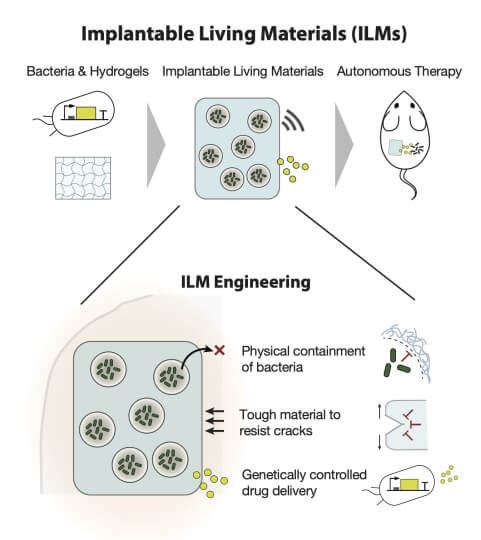
This illustration explains how the team designed Implantable Living Materials. Combined with the synthetically engineered bacteria, the new approach becomes a safe and autonomous functioning drug delivery device. Credit: Wyss Institute at Harvard University
<関連情報>
- https://seas.harvard.edu/news/materializing-safe-demand-living-therapeutics
- https://www.science.org/doi/10.1126/science.aec2071
埋め込み型生体材料は、封入された遺伝子操作細菌を用いて治療薬を自律的に送達する Implantable living materials autonomously deliver therapeutics using contained engineered bacteria
Tetsuhiro Harimoto, Fernando Herrero Quevedo, Janis Zillig, Sanjay Schreiber, […] , and David J. Mooney
Science Published:14 May 2026
DOI:https://doi.org/10.1126/science.aec2071
Editor’s summary
Engineered bacteria could serve as a source of long-term drug delivery, but they tend to escape confinement because of their small size and robust viability. Harimoto et al. created a polyvinyl alcohol (PVA) hydrogel matrix engineered for both high stiffness and high toughness that can contain bacteria without killing them off (see the Perspective by Chen and Hu). The hydrogel is used to trap engineered Escherichia coli that expresses a sense-and-respond genetic circuit designed to trigger the release of a protein antibiotic to clear Pseudomonas infection. This system was tested in vivo over a 6-month period, revealing positive treatment outcomes in a murine joint infection model. —Marc S. Lavine
Abstract
Microbes are increasingly used as living therapeutics, yet their uncontrolled dissemination in the body has remained a clinical roadblock. Physical containment remains largely unattainable owing to eventual bacteria escape. In this work, we present an implantable material that encapsulates and confines bacteria, wherein synthetically engineered microbes produce therapeutic payloads from within. We developed a hydrogel scaffold with dual mechanical features: high stiffness to regulate bacterial proliferation and high toughness to resist material fracture under physiological stress. This design achieved complete bacterial containment for 6 months and withstood multiple forms of mechanical loading that otherwise caused catastrophic material failure. By genetically engineering embedded bacteria, we endowed the material with environmental sensing and on-demand therapeutic release capabilities and demonstrated autonomous treatment in a murine prosthetic joint infection model.
