
2026-05-14 ジョージア工科大学
<関連情報>
- https://research.gatech.edu/soft-skin-nasal-patch-could-transform-sleep-monitoring
- https://www.me.gatech.edu/news/soft-skin-nasal-patch-could-transform-sleep-monitoring
- https://www.pnas.org/doi/10.1073/pnas.2605960123
皮膚に密着する柔らかい電子機器により、カニューレなしで睡眠呼吸をワイヤレスでモニタリングすることが可能 Soft, skin-interfaced electronics enable cannula-free wireless monitoring of sleep respiration
Byeongjun Lee, Hoon Yi, Jungmin Kim, +2 , and Woon-Hong Yeo
Proceedings of the National Academy of Sciences Published:May 13, 2026
DOI:https://doi.org/10.1073/pnas.2605960123
Significance
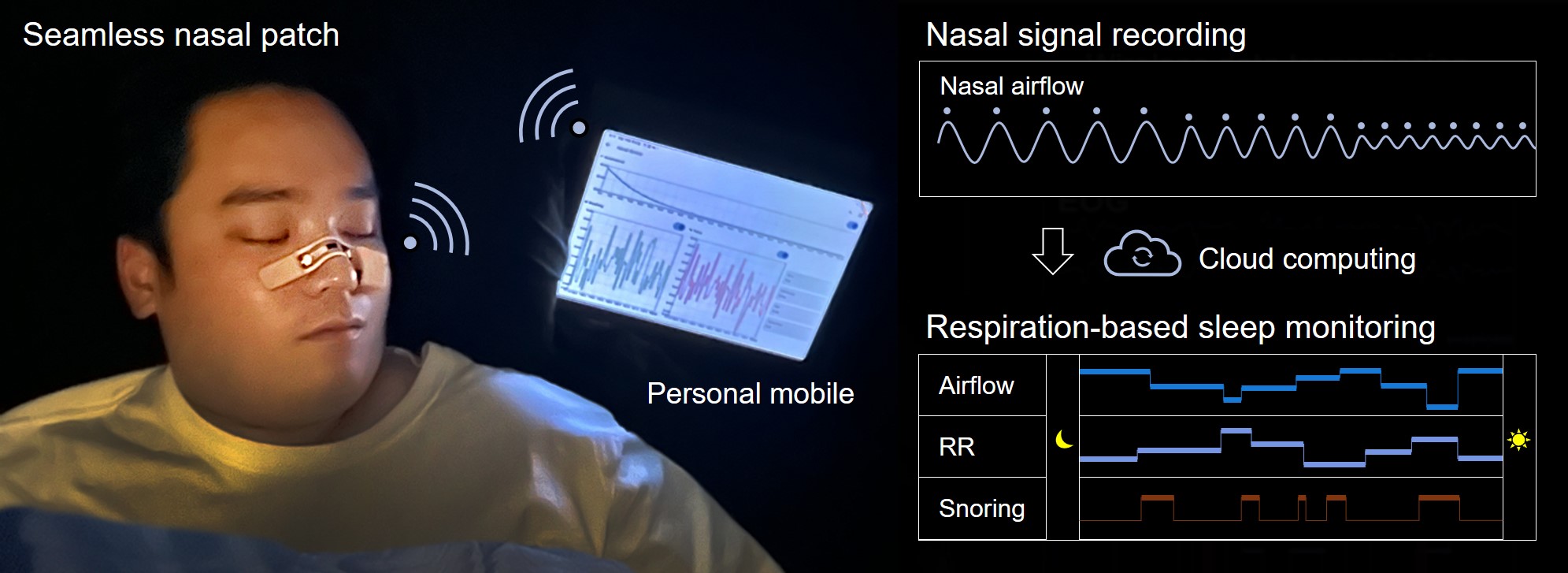
This study addresses limitations of conventional respiratory monitoring by introducing a cannula-free, skin-like nasal patch for at-home sleep monitoring. Rather than measuring airflow directly, the device senses airflow-induced soft-tissue deformation at the nasal surface, establishing a deformation-mediated sensing strategy. The ultrathin, conformal architecture minimizes mechanical burden while preserving signal fidelity. A scalable laser-induced graphene strain sensor, coupled with compliant liquid-metal interconnects, delivers stable, repeatable performance under physiologically relevant deformations. The modular design separates disposable skin-contact layers from reusable electronics, enabling hygienic reuse and continuous monitoring. This work demonstrates how integrating soft materials mechanics, strain transduction, and wireless electronics can produce practical, minimally obtrusive platforms for real-world respiratory monitoring.
Abstract
Sleep-related breathing disorders are prevalent yet frequently underdiagnosed, in part due to limitations of conventional respiratory monitoring technologies. Standard nasal cannulas introduce airflow resistance, discomfort, and poor long-term adherence, constraining at-home and longitudinal assessment. Here, we report a soft, skin-interfaced nasal patch that enables cannula-free, wireless monitoring of respiratory activity during sleep. The device is constructed from ultrathin, elastomeric materials that conform to the nasal surface, coupling respiratory-induced tissue deformation to a strain-sensing element. The mechanics of the skin–device interface and the elastomeric response govern the sensitivity and linearity of signal transduction, enabling quantitative capture of breathing dynamics. An integrated wireless platform transmits deformation signals directly to mobile devices, eliminating the need for external tubing or tethered modules. Modular fabrication permits replacement of the strain sensor and skin-contact interface without compromising mechanical performance. Mechanical characterization under physiologically relevant deformation demonstrates high repeatability and low hysteresis, while in vivo studies confirm that the patch accurately reproduces respiratory waveforms and correlates closely with gold-standard nasal cannula measurements. By integrating soft materials mechanics, wearable strain sensing, and wireless electronics, this system provides a minimally obtrusive platform for continuous respiratory monitoring. The class of technologies presented in this work establishes design principles for skin-interfaced devices, in which elastomeric mechanics, strain transduction, and wireless integration combine to enable quantitative, unobtrusive physiological monitoring in clinical and home environments.

