2026-06-01 名古屋市立大学
<関連情報>
- https://www.nagoya-cu.ac.jp/med/achievement/press-202606011300/
- https://www.nagoya-cu.ac.jp/med/media/pressrelease_202606011300.pdf
- https://www.cambridge.org/core/journals/the-british-journal-of-psychiatry/article/cognitive-and-behavioural-skills-to-prevent-major-depression-among-adults-with-subthreshold-depression-50week-followup-analysis-of-smartphone-cbt-randomised-trials-resilient-trial/C4D285AD1072A78996DE06633442C1F3
軽度うつ病の成人における大うつ病予防のための認知行動スキル:スマートフォンを用いた認知行動療法(CBT)無作為化試験(RESiLIENT試験)の50週間追跡分析 Cognitive and behavioural skills to prevent major depression among adults with subthreshold depression: 50-week follow-up analysis of smartphone CBT randomised trials (RESiLIENT trial)
Tatsuo Akechi,Hisashi Noma,Aran Tajika,Rie Toyomoto,Masatsugu Sakata,Yan Luo,Masaru Horikoshi,Norito Kawakami,Takeo Nakayama and Naoki Kondo,…
The British Journal of Psychiatry Published:01 June 2026
DOI:https://doi.org/10.1192/bjp.2026.10630
Abstract
Background
Major depression is a common and disabling disorder, and individuals with subthreshold depression represent a key at-risk group. We previously demonstrated that specific cognitive behavioural therapy (CBT) skills training delivered via a smartphone app (behavioural activation, cognitive restructuring, problem solving, assertion training and behavioural therapy for insomnia) improved depressive symptoms for up to 26 weeks.
Aims
To evaluate the long-term effects (up to 50 weeks) of CBT skills and their combinations for preventing major depressive episodes and reducing the total burden of depression (TBD).
Method
Participants were adults from the general population with subthreshold depression. A master protocol trial with four 2 × 2 factorial trials was used to randomise 3280 participants to one of nine intervention arms or a self-check control group. The primary outcome was time to onset of major depression by week 50.
Results
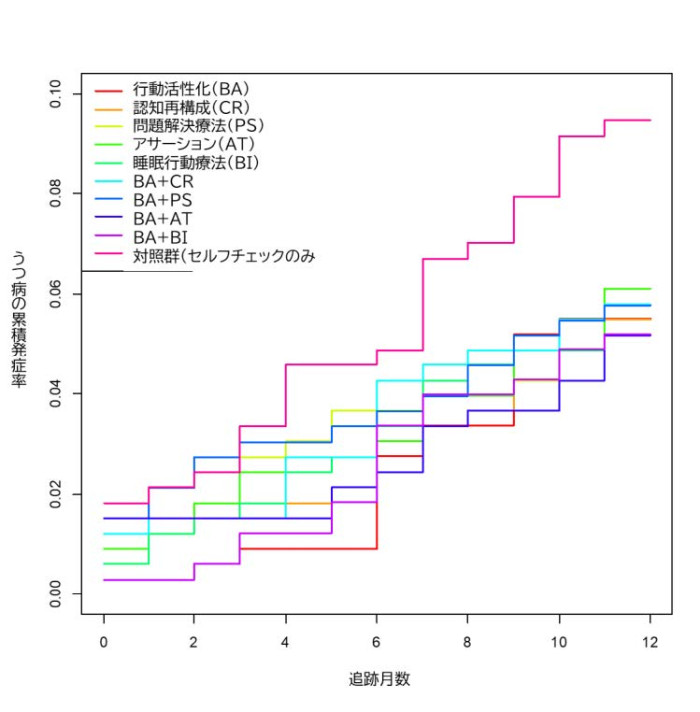
Hazard ratios for the interventions ranged from 0.52 (95% CI: 0.29–0.94) to 0.63 (95% CI: 0.36–1.10), with behavioural activation + assertion training showing the greatest preventive effect (number needed to treat: 23.3 (95% CI: 12.2 to 250)), followed by behavioural therapy for insomnia, behavioural activation + behavioural therapy for insomnia and cognitive restructuring. All interventions reduced TBD scores compared with control, with behavioural activation + cognitive restructuring exhibiting the largest reduction. Effect sizes at week 50 ranged from −0.34 to −0.07 and behavioural activation + cognitive restructuring was the most effective. No serious adverse events were reported.
Conclusions
The current findings indicated that specific CBT skills – particularly behavioural activation +assertion training , behavioural activation + cognitive restructuring and behavioural therapy for insomnia – effectively prevented the onset of depression and reduced the TBD at 50 weeks. Given its brevity, portability, accessibility and scalability, smartphone-based CBT is promising as a preventive intervention.