2026-06-03 山形大学,科学技術振興機構

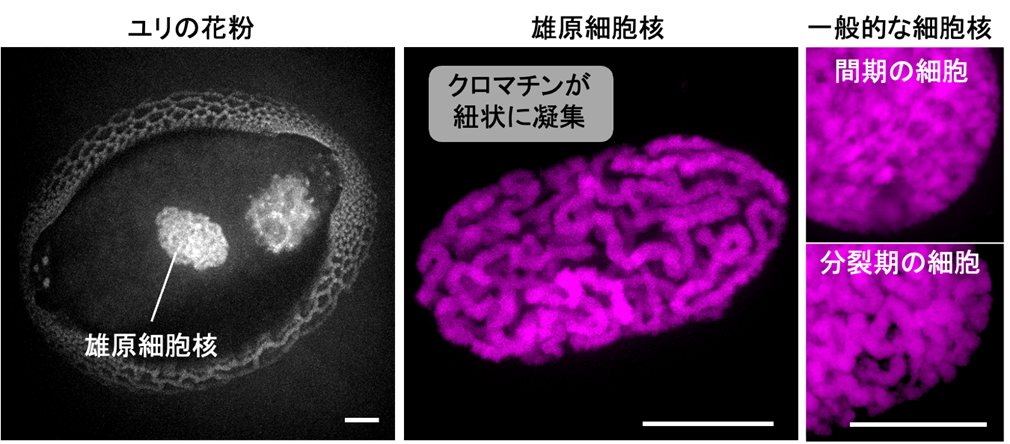
図1、雄原細胞核のクロマチン構造。
雄原細胞核のクロマチンは強く凝集し、外観は細胞分裂期の細胞核に類似する。
※間期の細胞とは、細胞が分裂を行っていない通常の細胞周期段階にある状態を指す。
スケールバーは10 µm(1 µm=100万分の1メートル)。
<関連情報>
- https://www.yamagata-u.ac.jp/jp/information/press/20260603_01/
- https://onlinelibrary.wiley.com/doi/10.1002/pld3.70175
花粉管の成長中、生殖細胞分裂には転写再活性化が必要であるが、初期の核再編成には必要ない Generative Cell Division, but Not Early Nuclear Reorganization, Requires Transcriptional Reactivation During Pollen Tube Growth
Mio K. Shibuta, Aina Komatsu, Tsugumi Aso
Plant Direct Published: 02 June 2026
DOI:https://doi.org/10.1002/pld3.70175
ABSTRACT
Bicellular pollen often enters a desiccated state wherein development is temporarily arrested, enabling long-term survival while maintaining the capacity for rapid activation upon hydration. Although the generative cell in mature pollen of Lilium species is known to have completed DNA replication, its precise cell-cycle status and the requirement for de novo transcription during pollen tube growth remain unclear. In this study, we examined the cell-cycle state and nuclear reactivation dynamics of the generative cell of Lilium longiflorum pollen using detailed confocal microscopy. We found that the generative cell nucleus in mature pollen exhibited prophase-like chromatin architecture but rapidly underwent transcriptional reactivation and chromatin decondensation upon hydration. This response is inconsistent with M-phase progression, which is irreversible and does not permit transcriptional reactivation or chromatin decondensation before chromosome segregation. Immunofluorescence analysis of cell-cycle markers showed that the generative cell lacked M-phase-specific features and instead displayed an interphase-like marker profile. Transcription inhibition experiments further revealed that chromatin decondensation and histone phosphorylation occurred independently of transcription, whereas generative cell division required de novo transcription. Together, these results define a unique nuclear state in which highly compacted chromatin is maintained while cell-cycle progression remains arrested in G2 and demonstrate that hydration triggers nuclear reactivation through sequential transcription-independent and transcription-dependent processes.