2026-06-03 東京大学
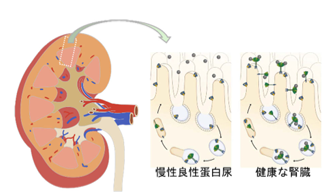
図:CUBN–AMN経路が機能的に破綻していることをヒトの腎組織で初めて直接証明
<関連情報>
- https://www.h.u-tokyo.ac.jp/press/20260603.html
- https://www.h.u-tokyo.ac.jp/press/__icsFiles/afieldfile/2026/06/03/release_20260603.pdf
慢性良性蛋白尿におけるCUBN-AMN経路の喪失 CUBN-AMN pathway loss in chronic benign proteinuria
Keiichi Takizawa ∙ Go Horie ∙ Yoichiro Oda ∙ … ∙ Atsushi Fujita ∙ Naomichi Matsumoto ∙ Yutaka Harita
Clinical Journey in Translational Medicine Published:June 3, 2026
DOI:https://doi.org/10.1016/j.kint.2026.03.023
The Clinical Journey
This case demonstrates that persistent isolated proteinuria, maintained for over a decade with entirely normal serum albumin and kidney function, can be the hallmark of a renal-limited cubilin-amnionless (CUBN-AMN) pathway defect rather than a primary podocytopathy. The patient’s clinical journey began in infancy, when proteinuria was incidentally detected (Figure 1a). Initial urine protein-to-creatinine ratios were approximately 230 mg/mmol (approximately 2 g/g Cr), subsequently stabilizing between 55 and 110 mg/mmol (between 0.5 and 1.0 g/g Cr). Despite this persistent proteinuria, kidney function, serum albumin, blood pressure, and growth remained normal. No clinical features suggestive of vitamin B12 deficiency, such as anemia or edema, were apparent; accordingly, serum vitamin B12 levels were not measured during the clinical course. At age 1 year, a kidney biopsy was performed. It revealed focal segmental glomerulosclerosis in a minority of glomeruli, without tubular atrophy, interstitial fibrosis, or immune deposits, and only focal podocyte foot process effacement (Supplementary Figure S1). Empirical treatment with corticosteroids and renin-angiotensin system inhibitors was started under the working diagnosis of steroid-resistant nephrotic syndrome, but proteinuria did not meaningfully improve despite stable kidney function (Figure 1a). At age 2 years, trio-based whole-exome sequencing was performed but remained initially uninformative. For the next several years, the child was monitored as having isolated persistent proteinuria. Despite the previously nondiagnostic genetic result, the patient’s distinctive clinical presentation—characterized by steroid resistance and an indolent course—prompted continued clinical follow-up under a high suspicion of a genetic etiology. At age 10 years, following the establishment of C-terminal CUBN-associated proteinuria (OMIM: 618884) as a distinct clinical entity,1 a genomic reanalysis was performed. This led to the identification of the compound heterozygous CUBN variants consisting of a C-terminal missense change and a synonymous variant at an exon-intron boundary predicted to impair splicing. This definitive diagnosis, compatible with the C-terminal CUBN-associated proteinuria spectrum (Figure 1b), finally allowed the cessation of further unnecessary immunosuppressive considerations. To clarify the tubular defect, immunofluorescence was performed on the original biopsy, assessing N- and C-terminal CUBN, AMN, and low-density lipoprotein receptor–related protein 2 compared with age-matched control tissue. In the patient, brush border staining of both CUBN epitopes and AMN was completely absent in proximal tubules whereas low-density lipoprotein receptor–related protein 2 localization was preserved (Figure 2; Supplementary Figure S2). However, faint cytoplasmic signals remained focally detectable for both proteins, suggesting that the variant impairs apical trafficking and leads to intracellular retention rather than a total loss of protein synthesis. At latest follow-up without any medication, the boy continued to exhibit stable subnephrotic proteinuria of ∼80 mg/mmol (∼0.7 g/g Cr) with preserved kidney function and no clinical features suggestive of vitamin B12 deficiency.