2026-06-05 中国科学院(CAS)
◆胃は体積の約3分の2を占め、一度に大量の餌を摂取・貯蔵できる一方、基礎代謝率(BMR)は極めて低い。さらに、共生細菌由来の水平遺伝子転移によって獲得したND1遺伝子が、エネルギー代謝の調節に重要な役割を果たしていることを発見した。この遺伝子はヒストンアセチル化によるエピジェネティック制御を受け、高発現することで代謝ネットワークを調節する。ゼブラフィッシュや線虫などへの導入実験では、低温環境下で代謝活性を抑制し、飢餓耐性を高めることが確認された。本研究は、深海巨大動物が水平遺伝子転移とエピジェネティクスを利用してエネルギー配分を最適化する新たな進化戦略を初めて示したものであり、極限環境への適応機構の理解に重要な知見を提供する。
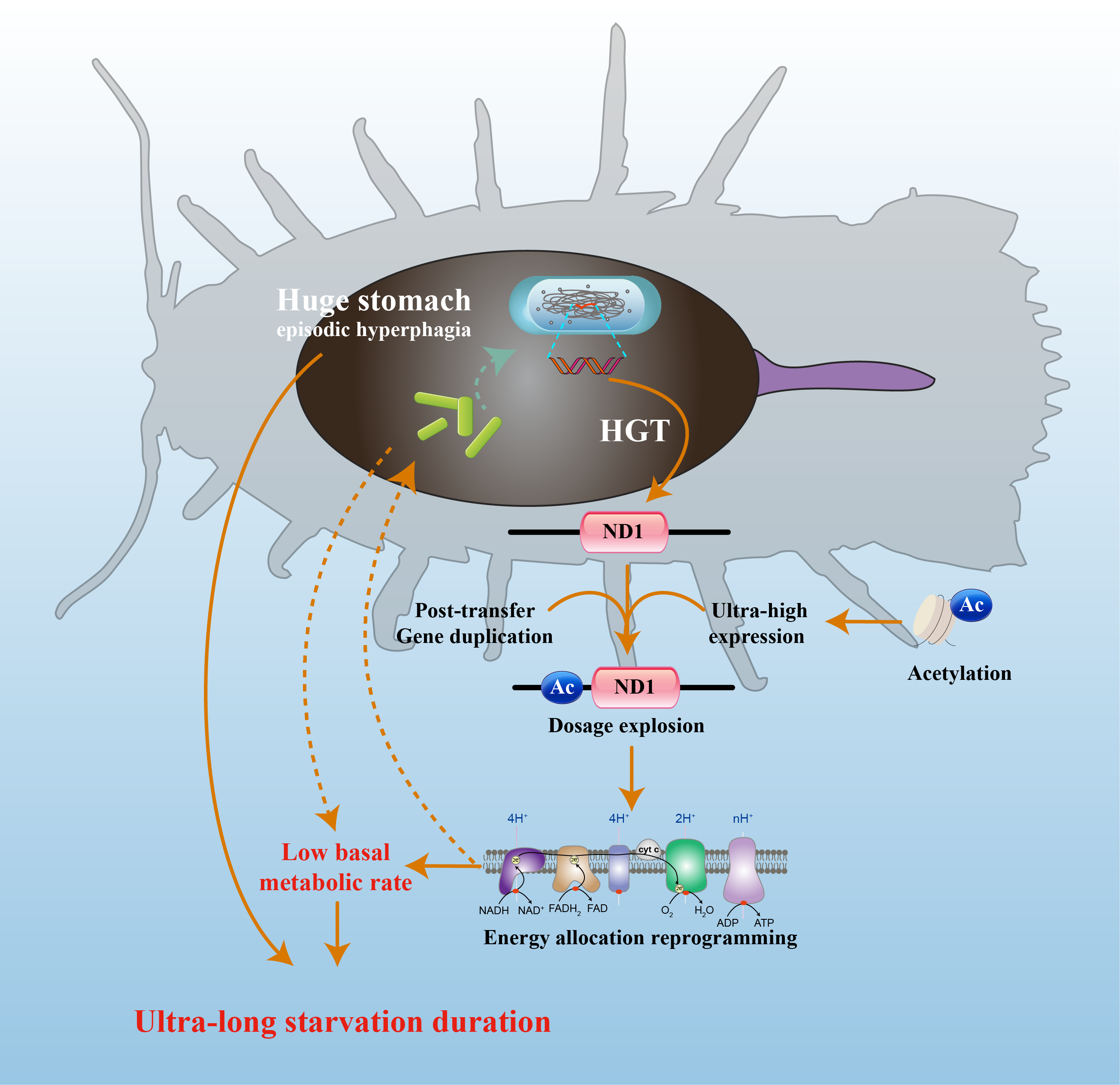
Mechanism diagram showing the survival strategy and horizontally acquired energy metabolism-related gene in reprogramming energy allocation in deep-sea isopods. (Image by YUAN Jianbo, et al.)
<関連情報>
- https://english.cas.cn/newsroom/research-news/202606/t20260602_1160354.shtml
- https://www.cell.com/cell/abstract/S0092-8674(26)00571-4
深海巨大動物は、超長期の飢餓に耐えるために微生物のエネルギー代謝遺伝子を転用する Deep-sea megafauna co-opts microbial energy metabolism genes to withstand ultra-long starvation
Jianbo Yuan ∙ Xiaojun Zhang ∙ Shihao Li ∙ … ∙ Kahou Chu ∙ Jianhai Xiang ∙ Fuhua Li
Cell Published:June 5, 2026
DOI:https://doi.org/10.1016/j.cell.2026.05.012
Highlights
- Deep-sea isopods hijack an energy metabolism gene (ND1) via ancient horizontal transfer
- ND1 achieves dosage explosion through post-transfer duplication and ultra-expression
- ND1 extends starvation survival by 37% in zebrafish under low metabolism
- ND1 resolves the energy trade-off between gigantism demand and starvation survival
Summary
The deep-sea supergiant isopod is renowned for surviving over 5 years without food, which is a crucial adaptive trait for megafauna inhabiting extreme environments. Here, morphological, physiological, and genomic comparisons of deep-sea isopods reveal a dual adaptive strategy underlying this trait: a distended, food-retentive stomach that enables episodic hyperphagia and a markedly reduced basal metabolic rate (BMR). Notably, central to this adaptation is the ancient horizontal acquisition of the microbial energy metabolism-related gene ND1, which thereafter achieved significant dosage enhancement via post-transfer duplication and ultra-high expression that is specifically regulated by histone acetylation at its promoter. Functional assays in transgenic zebrafish, nematodes, and cell lines demonstrate that ND1 reduces BMR by downregulating endogenous energy-production genes and thus extends starvation survival under cold-induced metabolic suppression. These findings uncover an exceptional evolutionary strategy whereby deep-sea megafauna co-opts and epigenetically optimizes exogenous microbial genes to reconcile the metabolic conflict between energy-demanding gigantism and extreme energy limitation.