2026-07-21 京都大学
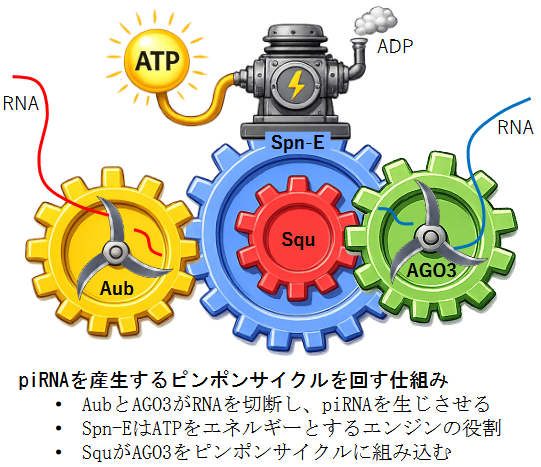
河口真一、ChatGPT5.5で作成したものを改変
<関連情報>
- https://www.kyoto-u.ac.jp/ja/research-news/2026-07-21-0
- https://www.cell.com/iscience/fulltext/S2589-0042(26)02298-4
Squashは、ショウジョウバエの卵巣においてSpindle-E依存性の異種piRNA増幅を可能にする Squash enables Spindle-E-dependent heterotypic piRNA amplification in the Drosophila ovary
Xin Xu ∙ Taichiro Iki ∙ Shinichi Kawaguchi ∙ Toshie Kai
iScience Published:July 20, 2026
DOI:https://doi.org/10.1016/j.isci.2026.116920
Highlights
- Squ loss reduces Ago3 protein, impairing heterotypic piRNA amplification
- Squ interacts with Spn-E to enable efficient piRNA biogenesis
- Squ stabilizes Ago3 independently of Spn-E
Summary
The PIWI-interacting RNA (piRNA) pathway represses mobile transposable elements (TEs) to protect genome integrity in animal gonads. In Drosophila ovaries, piRNAs are generated in the nuage, a membrane-less organelle enriched with piRNA factors. Squash (Squ) is a key component for piRNA-mediated TE silencing, but its molecular function remains unclear. Here, we show that loss of Squ impairs piRNA biogenesis, causing abnormal accumulation of precursor transcripts and destabilization of Ago3. Reduction of Ago3 enhances Aub-Aub homotypic ping-pong instead of Aub-Ago3 heterotypic piRNA amplification. Furthermore, we demonstrate that Squ acts as a cofactor of the RNA helicase spindle-E (Spn-E), which is crucial for piRNA biogenesis. Disrupting the Squ-Spn-E interaction leads to TE de-repression and defective precursor processing, indicating that Squ cooperates with Spn-E to ensure proper piRNA biogenesis. Together, these findings identify Squ as a critical factor for Spn-E-dependent heterotypic piRNA amplification in the Drosophila ovary.