2026-10-29 海洋研究開発機構,日本電子株式会社,産業技術総合研究所,大阪公立大学,生命創成探究センター,生理学研究所,京都大学,名古屋大学,株式会社マリン・ワーク・ジャパン
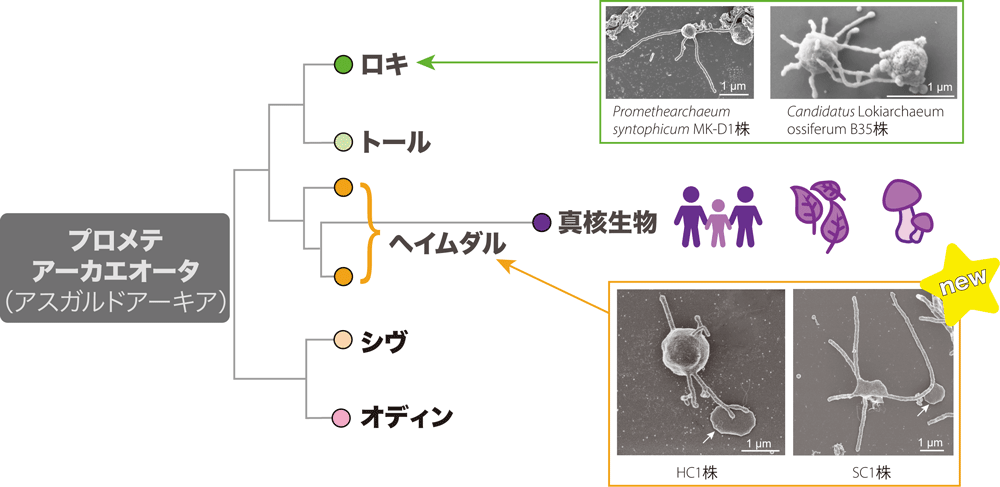
図1.プロメテアーカエオータと真核生物の進化的な関係、および培養株の電子顕微鏡写真
(B35株の電子顕微鏡写真はRodriges-Oliveira et al., 2023. Nature(doi: 10.1038/s41586-022-05550-y)より転載)
<関連情報>
- https://www.jamstec.go.jp/j/about/press_release/20261029/
- https://www.nature.com/articles/s41586-026-11170-7
真核生物に最も近縁なアーキアは、単純な細胞内部構造を持ち、他の微生物と共生してペプチドを栄養源として生きる Eukaryotes’ closest relatives are internally simple syntrophic peptidotrophic archaea
Hiroyuki Imachi, Masaru K. Nobu, Shun’ichi Ishii, Hiroki Hashiguchi, Yuga Hirakata, Naoki Hosogi, Tetsuro Ikuta, Yuta Isaji, Makoto Miyata, Masayuki Miyazaki, Yuki Morono, Kazuyoshi Murata, Satoshi Nakagawa, Akihiro Narita, Miyuki Ogawara, Satoshi Okada, Yumi Saito, Sanae Sakai, Shigeru Shimamura, Yuhei O. Tahara, Yoshihiro Takaki, Yoshinori Takano, Eiji Tasumi, Katsuyuki Uematsu, …Ken Takai
Nature
DOI:
Abstract
Eukaryotes are theorized to have an origin associated with the archaeal phylum Promethearchaeota (formerly Asgard archaea)1,2,3. The first cultured representatives revealed valuable insights4,5 but are still distantly related to eukaryotes, leaving many unknowns regarding eukaryogenesis. Here we report the isolation of two strains, HC1 and SC1, that belong to the archaeal lineage that branches closest to eukaryotes (Heimdallarchaeia);6,7,8 these isolates are members of a pure co-culture and a tri-culture with methanogenic partners. Both are obligately anaerobic, syntrophic, peptide-degrading and mesophilic archaea that produce protrusions and vesicles but lack persistent internal membrane structures, like Promethearchaeales4,5. All Promethearchaeota isolates demonstrate behaviour focused on cell construction and membrane structures rather than division, in contrast to typical prokaryotes9. Strain HC1 possesses genes associated with aerobic lifestyles (such as cytochrome c oxidase (Cox)) but co-cultures cannot grow under (micro)oxic conditions. Meanwhile, the strain demonstrates growth under microoxic conditions when in the presence of aerobes, suggesting that Cox supports oxygen detoxification rather than respiration. Comparative genomics provides evidence that, like HC1, Cox-possessing Heimdallarchaeia studied to date probably do not respire oxygen. The wide conservation of anaerobiosis, cell structure without persistent intracellular membranes and membrane protrusions across Promethearchaeota suggest that the archaeal ancestor of eukaryotes may have had such physiological features. In this cultivation-informed scenario for eukaryogenesis, the archaea–eukaryote transition would involve a steep transition in cell structure and physiological shift from anaerobiosis to (facultative) aerobiosis10, with early interactions between the archaeal host and mitochondrial ancestor probably occurring under low-oxygen conditions and at least partially mediated by oxygen detoxification.