2026-06-05 中国科学院(CAS)
◆IS110は細菌に存在する可動性DNA因子であり、近年、ブリッジRNA(bRNA)を利用して供与DNAと標的DNAを認識することが判明し、新たなゲノム編集技術として注目されている。しかし、そのDNA転移機構は不明だった。本研究ではCaloranaerobacter azorensis由来のCazIS110-1を解析し、IS110が従来想定されていた「切り出して貼り付ける(cut-out-paste-in)」単一経路ではなく、2種類の異なる経路を用いることを発見した。一方は完全長bRNAに誘導されて8の字状DNA中間体を形成する経路であり、もう一方はDNA中間体を形成せず標的部位へ直接転移する「direct-transfer」経路である。さらに、トランスポザーゼのRuvC様触媒中心とTnpドメイン内の保存セリン残基が協調してDNA切断と転移反応を制御することを明らかにした。これらの成果はRNA誘導型トランスポゾンの理解を深めるとともに、次世代のプログラム可能なゲノム編集技術開発の基盤となる。
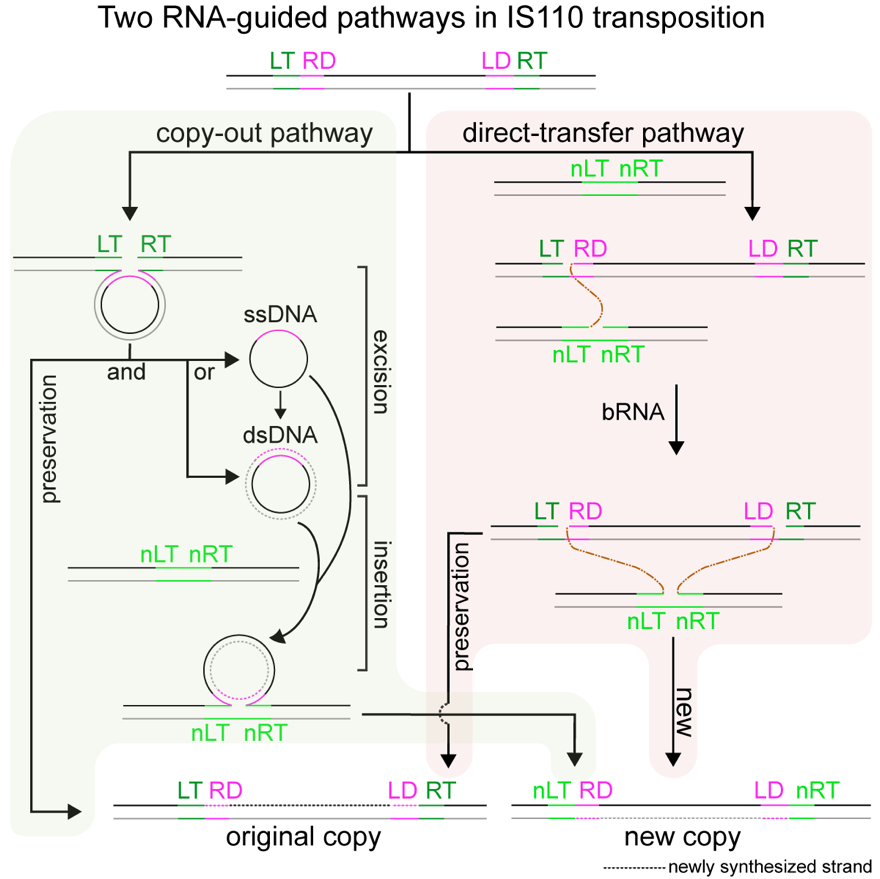
Model of dual RNA-guided transposition pathways (Image by TIB)
<関連情報>
- https://english.cas.cn/newsroom/research-news/202606/t20260605_1161309.shtml
- https://www.sciencedirect.com/science/article/abs/pii/S1097276526003151
IS110トランスポゾンは、機構的に異なる2つのRNA誘導型転移経路を利用する IS110 transposon utilizes two mechanistically distinct RNA-guided transposition pathways
Xuanlong Sun, Chen Yang, Zhaohui Cai, Li Liu, Xinmin Yue, Shuquan Rao, Huiqiang Lou, Chaoyou Xue
Molecular Cell Available online: 1 June 2026
DOI:https://doi.org/10.1016/j.molcel.2026.05.009
Highlights
- IS110 transposons use two distinct RNA-guided transposition pathways
- Bridge-RNA drives top-strand excision and rejoining via a copy-out mechanism
- Target-binding loop and bridge RNAs enable direct top-strand transfer to new targets
- Top-strand integration dominates in these RNA-guided transposition pathways
Summary
The IS110 elements employ RNA-guided transposases using bridge-RNA to coordinate donor and target DNA recognition and integration via donor- and target-binding loops, which offers promise for DSB-free genome editing. However, their transposition mechanism remains unclear, with prior inconsistent observations. Using an IS110 element from Caloranaerobacter azorensis, we show that IS110 transposons utilize two independent transposition pathways. The first depends on bridge-RNA (bRNA) and excises the element via top-strand excision and rejoining, which corresponds to the initial step of the canonical copy-out model and revisits the earlier cut-out model. Integration occurs predominantly through top-strand insertion, which suggests an alternative to the Holliday junction-mediated dual-strand mechanism. The second involves cooperation between a truncated target-binding loop RNA and bRNA, which enables direct top-strand transfer to a new target via two sequential reactions. Both pathways preserve the original transposon copy. These findings redefine the mechanistic understanding of IS110 transposition and reconcile prior discrepancies, thus offering an insight into programmable, RNA-guided genome modification.