20026-06-08 カナダ・ブリティッシュコロンビア大学(UBC)
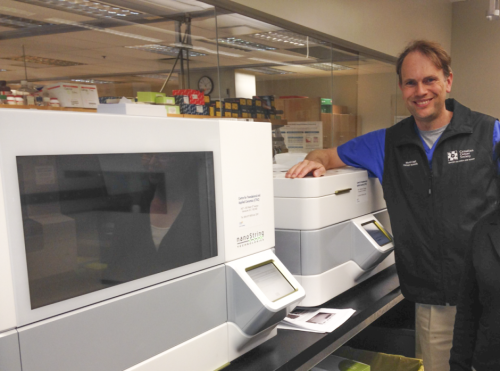
Dr. Torsten Nielsen at work in his laboratory at BC Cancer (circa 2014), standing beside the nanoString nCounter device used to generate much of the data leading to the approval of the Prosigna test in its FDA-cleared format.
<関連情報>
- https://news.ubc.ca/2026/06/genomic-test-breast-cancer-ubc/
- https://ascopubs.org/doi/10.1200/JCO.2026.44.16_suppl.500
First results from the OPTIMA phase III randomized non-inferiority trial of test-directed chemotherapy in patients with high clinical risk ER-positive HER2-negative early breast cancer.
Robert C. Stein, Andreas Makris, Iain R. Macpherson, Luke Hughes-Davies, Andrea Marshall, Sarah E. Pinder, Abeer Shaaban, … , OPTIMA Investigators and Trial Management Group
Journal of Clinical Oncology Published:May 27, 2026
DOI:https://doi.org/10.1200/JCO.2026.44.16_suppl.500
Abstract
Background: Tumor gene expression tests are widely used to assist adjuvant chemotherapy decisions for women with early breast cancer (EBC). OPTIMA (Optimal Personalised Treatment of early breast cancer using Multi-parameter Analysis) is an international RCT comparing chemotherapy decisions made with the Prosigna (PAM50) gene expression test with standard treatment in mostly node-positive patients.
Methods: Women and men aged >40 recommended to receive chemotherapy for ER+ HER2- EBC with 0-9 involved axillary nodes and T size >30mm if node negative were eligible. Randomization was between standard chemotherapy followed by endocrine therapy (CET) or to a Prosigna test directed chemotherapy decision. Patients with Prosigna ROR score > 60 tumors were assigned CET whilst those with low ROR score (≤60) tumors received endocrine therapy (ET) alone. ET for premenopausal women included ovarian function suppression (OFS) in the absence of chemotherapy-induced ovarian insufficiency. ROR scores were not disclosed, and patients receiving CET were blinded to their randomization. OPTIMA was designed to demonstrate non-inferiority (NI) of 5-year invasive breast cancer free survival (IBCFS) in the test-directed arm with a 3% margin in the per protocol (PP) population using a 5% 1-sided alpha. Control arm testing allowed treatment comparison within the low ROR score population at a 3.5% NI margin.
Results: From 16th Jan 2017 to 12th Dec 2025 4429 patients were randomized, 2215 to the control arm and 2214 to the test-directed arm of whom 2061 (93%) and 2097 (95%) were included in the respective PP group. Patient characteristics in the PP population were well-balanced; 62% were postmenopausal, 37% premenopausal and 0.8% male. 73% had pN1/pN1sn, 8% had pN0/pN1mi and 19% had pN2 tumors. 68% had low ROR score tumors. With a median follow-up of 3.9 years (interquartile range 2.0-5.9), 280 IBCFS events occurred (141 on control arm; 139 on test directed arm) of which 66% were distant recurrences. The 5-year IBCFS rate in the control arm was 91.5% [95% CI 89.7- 92.9%] and 90.4% [95% CI 88.6- 92.0%] in the test-directed arm, Hazard Ratio (HR) 0.99 [90% CI 0.81- 1.20], NI p = 0.013, thereby meeting the pre-defined NI margin. The corresponding 5-year IBCFS rates for the low ROR score population were 94.9% [95% CI 92.9- 96.4%] and 93.7% [95% CI 91.8- 95.2%] for the two arms respectively, HR 1.06 [90% CI 0.78- 1.46] NI p = 0.0051 again demonstrating non-inferiority. There was no significant outcome heterogeneity between subgroups including for menopausal and nodal status.
Conclusions: The OPTIMA trial demonstrates that women and men with ER+ HER2- EBC and ROR score ≤60 tumors can safely avoid chemotherapy. It provides evidence for the utility of test-directed chemotherapy in premenopausal women treated with OFS and patients with high levels of nodal involvement. Clinical trial information: ISRCTN42400492.