2026-06-09 北海道大学
<関連情報>
- https://www.hokudai.ac.jp/news/2026/06/post-2323.html
- https://link.springer.com/article/10.1007/s11357-026-02338-0
中高強度の身体活動と脳内アミロイド蓄積が認知機能の経時的変化に及ぼす相互作用 Interaction of moderate-to-vigorous physical activity and brain amyloid accumulation on longitudinal cognitive change
Keitaro Makino,Takashi Kato,Kengo Ito,Osamu Katayama,Ryo Yamaguchi & Hiroyuki Shimada
GeroScience Published:25 May 2026
DOI:https://doi.org/10.1007/s11357-026-02338-0
Abstract
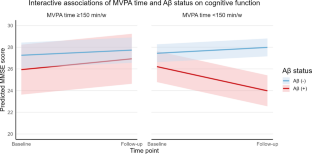
Amyloid β (Aβ)–related cognitive decline is a key target for dementia prevention; however, the intensity-dependent modifying role of physical activity remains unclear. We investigated whether moderate-to-vigorous physical activity (MVPA) and walking activity attenuate Aβ-related cognitive decline. This cohort study included 74 community-dwelling older adults who underwent Aβ positron emission tomography and repeated cognitive assessments using the Mini-Mental State Examination (mean interval = 23.6 ± 0.9 months). Aβ positivity was defined as a global standardized uptake value ratio > 1.10. Physical activity was assessed with the International Physical Activity Questionnaire–Short Form. MVPA time was categorized using the World Health Organization threshold (≥ 150 min/week), and walking time was dichotomized at the median. Linear mixed-effects models tested three-way interactions among time, Aβ status, and physical activity, adjusting for age, sex, and education. The mean age was 72.7 ± 5.5 years and 44.6% were women; 18 participants (24.3%) were Aβ positive. Aβ positivity was associated with greater cognitive decline among participants with lower MVPA, whereas little or no decline was observed among those with higher MVPA (β for Time × Aβ × MVPA interaction = − 3.30; 95% CI, − 6.35 to − 0.25; p = 0.034). No significant interaction was observed for walking activity (β for Time × Aβ × Walking interaction = 1.43; 95% CI, − 1.48 to 4.35; p = 0.331). Higher MVPA was associated with less pronounced Aβ-related cognitive decline, suggesting an intensity-dependent effect of physical activity. These findings support the cognitive benefits of MVPA in the context of cerebral amyloid burden.