2026-06-12 熊本大学
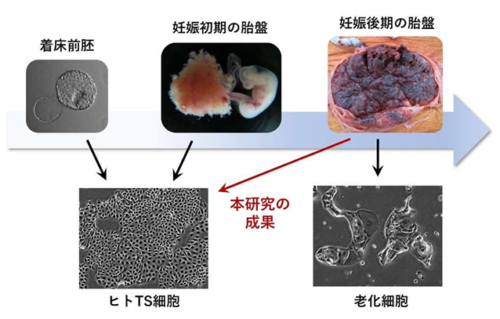
図1. 妊娠後期胎盤からのヒトTS細胞の樹立 これまで、妊娠後期の胎盤から効率よく TS 細胞を作製することは困難でした。本研究では、妊娠後期の栄養膜細胞に、細胞老化を抑える因子と幹細胞性を維持する遺伝子「SALL4」を導入し、さらに細胞増殖を抑制する遺伝子群の働きを一時的に抑えることで、TS細胞を効率よく作製することに成功しました。
<関連情報>
- https://www.kumamoto-u.ac.jp/whatsnew/seimei-sentankenkyu/20260612-2
- https://www.kumamoto-u.ac.jp/daigakujouhou/kouhou/pressrelease/wgt3jw/release260612-2.pdf
- https://www.pnas.org/doi/10.1073/pnas.2537884123
妊娠後期胎盤からヒト栄養膜幹細胞を採取するための堅牢な方法の開発とその妊娠高血圧症への応用 Development of a robust method to derive human trophoblast stem cells from late-gestation placentas and its application to preeclampsia
Akira Oike, Eri H. Kobayashi, Yasuhiro Yamamoto, +13 , and Hiroaki Okae
Proceedings of the National Academy of Sciences Published:June 11, 2026
DOI:https://doi.org/10.1073/pnas.2537884123
Significance
Trophoblasts play central roles in placental development and function. Although trophoblast dysfunction underlies many pregnancy complications, the molecular pathogenesis remains poorly understood due to the scarcity of appropriate experimental models. Here we develop a method to derive human trophoblast stem cells (hTSCs) from late-gestation placentas and apply it to the study of preeclampsia (PE), a hypertensive pregnancy disorder. PE is characterized by impaired trophoblast invasion and dysregulated angiogenic factor secretion, and PE-derived hTSCs recapitulate key aspects of these abnormalities. These findings demonstrate the utility of hTSCs as a platform for studying pregnancy complications.
Abstract
Trophoblasts are multifunctional cells in the placenta and essential for normal pregnancy. Although trophoblast dysfunction can cause pregnancy complications, the underlying mechanisms remain unclear, and effective treatments are limited, partly because of the scarcity of appropriate experimental models. We previously reported the derivation of human trophoblast stem cells (hTSCs) from 1st-trimester placentas and blastocysts, providing a powerful tool to investigate human trophoblast development and function. However, the difficulty in deriving hTSCs from late-gestation placentas has limited their application to pregnancy complication research. Here we report a robust technique to derive hTSCs from term placentas based on the transient expression of a p53 dominant negative mutant, SALL4, and shRNAs against cyclin-dependent kinase inhibitors. Using this technique, we derived and characterized hTSCs from placentas obtained from patients with early-onset preeclampsia (PE). PE-derived hTSCs exhibit impaired trophoblast invasion and reduced placental growth factor secretion, consistent with trophoblast abnormalities reported in PE. Therefore, this study provides a technological basis for investigating pregnancy complications associated with trophoblast dysfunction.