2026-06-12 長寿医療研究センター
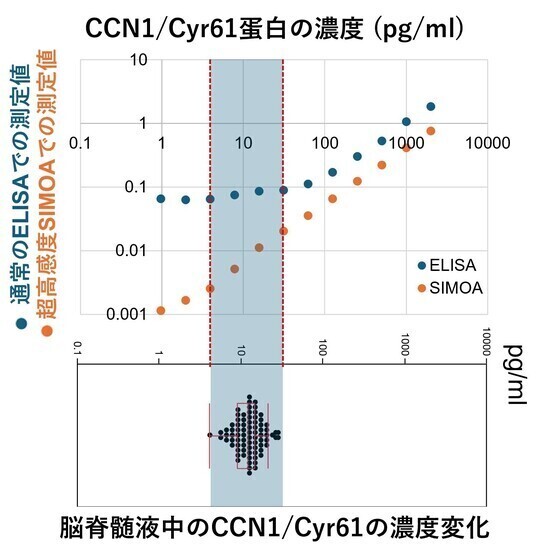
図1.開発した超高感度測定系SIMOAによる脳脊髄液中のCCN1/Cyr61の濃度変化の測定
<関連情報>
- https://www.ncgg.go.jp/ri/report/20260612.html
- https://www.cell.com/iscience/fulltext/S2589-0042(26)01619-6
CCN1/Cyr61はヒト脳脊髄液中のβアミロイド濃度と関連する CCN1/Cyr61 associates with β-amyloid levels in human cerebrospinal fluids
Mitsuru Shinohara ∙ Hiroyuki Momota ∙ Tsuyoshi Saito ∙ … ∙ Takeshi Ikeuchi ∙ Akio Fukumori ∙ Naoyuki Sato
iScience Published:June 5, 2026
DOI:https://doi.org/10.1016/j.isci.2026.116244
Highlights
- We developed a highly sensitive CCN1/Cyr61 quantification assay using SIMOA
- CCN1/Cyr61 in CSF strongly correlated with Aβ species and phosphorylated tau
- CCN1/Cyr61 showed moderate associations with glial and other cellular markers
- These findings indicate CCN1/Cyr61 may be involved in Alzheimer’s disease pathology
Summary
CCN1, also called Cyr61, is a secreted protein involved in diverse biological processes including senescence. While elevated in brains of Alzheimer’s disease (AD) models and patients, CCN1/Cyr61 levels in cerebrospinal fluid (CSF) remain unclear. Using a high-sensitive quantification method, we analyzed CSF samples from 79 subjects (age: 77.7 ± 5.4 years [63–94], MMSE: 20.1 ± 5.9 [0–30]) who underwent CSF tap test. CCN1/Cyr61 showed strong associations with Aβ40 (r = 0.67), Aβ42 (r = 0.48), Aβ42/40 ratio (r = −0.53), and phospho-tau levels (r = 0.53) (all; p < 0.0001). CCN1/Cyr61 also moderately associated with glial markers, YKL-40, sTREM2, CD163, and a lymphatic endothelial marker, LYVE-1 (r ≈ 0.4). While these cellular markers also associated with Aβ and phospho-tau, effects were much weaker. Collectively, CCN1/Cyr61 is associated with Aβ species and p-tau in CSF. These associations are considerably stronger than those observed with typical glial or other cellular markers, providing a clue to understanding the link between senescence and AD pathology at the levels of fluid biomarkers.