2026-06-25 藤田医科大学,学習院大学,滋賀医科大学,量子科学技術研究開発機構,大阪公立大学,東京都立大学,名古屋大学
<関連情報>
- https://www.fujita-hu.ac.jp/news/vsfo8q000001r6qc.html#top
- https://link.springer.com/article/10.1186/s13195-026-02056-x
VRベースの経路統合は、急速な皮質機能低下の個人的リスクを予測する:認知機能に障害のない成人を対象とした1年間の縦断研究 VR-based path integration predicts individual risk of rapid cortical decline: a one-year longitudinal study in cognitively unimpaired adults
Kazuya Kawabata,Sayuri Shima,Reiko Ohdake,Epifanio Bagarinao,Yasuaki Mizutani,Harutsugu Tatebe,Riki Koike,Atsushi Kasai,Akihiro Ueda,Mizuki Ito,Junichi Hata,Shinsuke Ishigaki,Hiroshi Toyama,Takahiko Tokuda,Akihiko Takashima & Hirohisa Watanabe
Alzheimer’s Research & Therapy Published:20 April 2026
DOI:https://doi.org/10.1186/s13195-026-02056-x
Abstract
Background
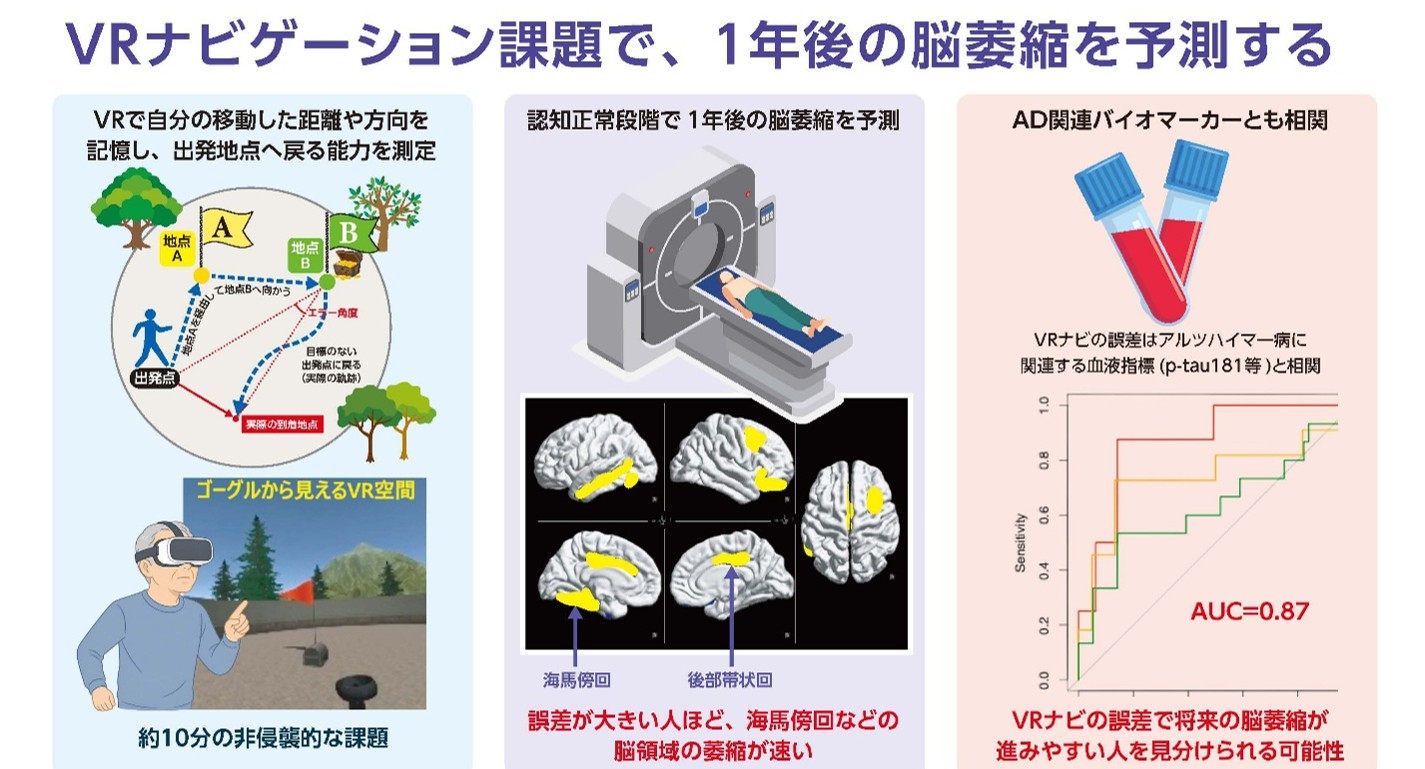
Path integration (PI) is a navigational computation that can be affected by aging and Alzheimer’s disease (AD). Virtual-reality PI (VR-PI) preferentially engages medial temporal circuits and can reveal subtle changes that occur prior to overt impairment. Nevertheless, the longitudinal association between PI performance and structural brain changes remains unclear.
Methods
In a 1-year longitudinal cohort of 71 cognitively unimpaired adults, we assessed baseline VR-PI performance (PI error and angular error), AD-related plasma biomarkers (p-tau181 and glial fibrillary acidic protein [GFAP]), and longitudinal cortical thickness and volume from MRI scans acquired one year apart, to examine whether baseline PI performance was associated with both plasma biomarkers and subsequent structural brain changes. Linear mixed-effects (LME) models were used to assess whether baseline PI performance predicted time-dependent regional thinning and atrophy.
Results
Greater baseline PI error was associated with greater longitudinal cortical thinning and volume decline in the parahippocampal gyrus, middle temporal gyrus, posterior cingulate cortex, and caudal middle frontal gyrus. Similar spatial patterns were observed for angular error, indicating consistent associations across PI measures. Sensitivity analyses using extended models that additionally included either APOE ε4 status or the baseline age × time interaction, as well as analyses restricted to participants aged ≥ 40 years, did not materially alter the pattern of results. Both baseline PI error and angular error were associated with plasma p-tau181 (r = 0.38 for both, 95% confidence interval [CI]: 0.16–0.56), and PI error was associated with GFAP levels (r = 0.36, 95% CI: 0.14–0.55). Receiver operating characteristic (ROC) curve analyses showed that baseline PI error best discriminated individuals with accelerated parahippocampal thinning (10% threshold; cross-validated AUC = 0.87).
Conclusions
Baseline VR-PI performance was associated with longitudinal cortical thinning and volume decline in AD-vulnerable regions, along with additional associations with plasma p-tau181 and GFAP levels. VR-PI performance may reflect both molecular (blood biomarker) and structural (MRI) signatures preceding overt clinical impairment.