2026-06-25 北海道大学
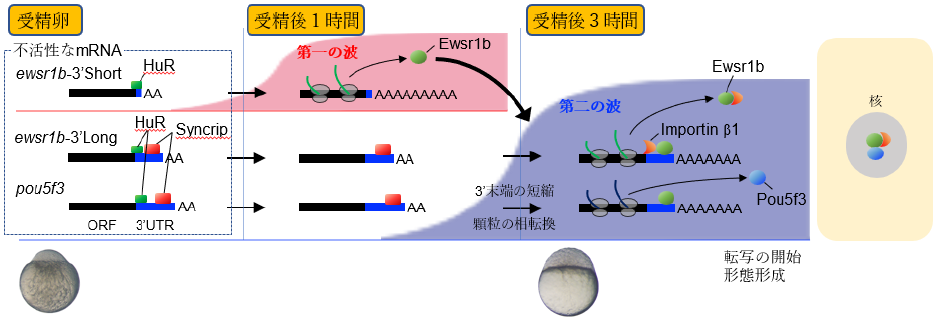
受精後の翻訳の波。卵は多くの不活性なmRNAを持つ(受精卵)。受精後1時間で複数のmRNAが活性化し、この第一の波で合成されたEwsr1bタンパク質は、第二の波の形成を促進する。合成されたタンパク質は、発生の様々な現象を進行させる。
<関連情報>
- https://www.hokudai.ac.jp/news/2026/06/post-2337.html
- https://www.cell.com/cell-reports/fulltext/S2211-1247(26)00635-2
選択的3’UTRとRNA結合タンパク質、Ewsr1bとHuR、Syncripは胚発生を進行させるために翻訳の連続した波を形成する Alternative 3′ UTRs and RNA-binding proteins Ewsr1b, HuR, and Syncrip organize sequential waves of translation to drive embryonic development
Keisuke Sato ∙ Ludivine Fierro ∙ Anyu Suginishi ∙ Takahiro Sanada ∙ Tomoya Kotani
Cell Reports Published:Published: June 13, 2026
DOI:https://doi.org/10.1016/j.celrep.2026.117557
Highlights
- The first wave of translation including ewsr1b mRNA begins within 1 h postfertilization
- The synthesized Ewsr1b promotes the second wave of translation including pou5f3 mRNA
- HuR and Syncrip decline postfertilization, promoting the first and second waves, respectively
- The sequential waves of translation drive diverse developmental processes
Summary
Eggs of many species accumulate thousands of dormant mRNAs that are translated after fertilization at specific times and locations to direct development. However, how embryos coordinate translation of these mRNAs remains unclear. In this study, we identify sequential waves of translation critical for proper development progression. The first wave occurs within 1 h and includes translation of ewsr1b mRNA that harbors a short 3′ untranslated region (UTR) comprising 16 nucleotides. The resulting Ewsr1b protein triggers the second translation wave through binding cytoplasmic mRNAs, including pou5f3, which encodes a transcription factor promoting zygotic genome activation. In contrast, HuR and Syncrip repress translation until the first and second waves, respectively. ewsr1b mRNA that has a long 3′ UTR is translated in the second wave, and the 3′ UTR’s length determines protein localization and function. Overall, our findings reveal previously unknown molecular principles that coordinate translation timings and protein functions to drive long-term, multilayered processes.