2026-04-28 京都大学
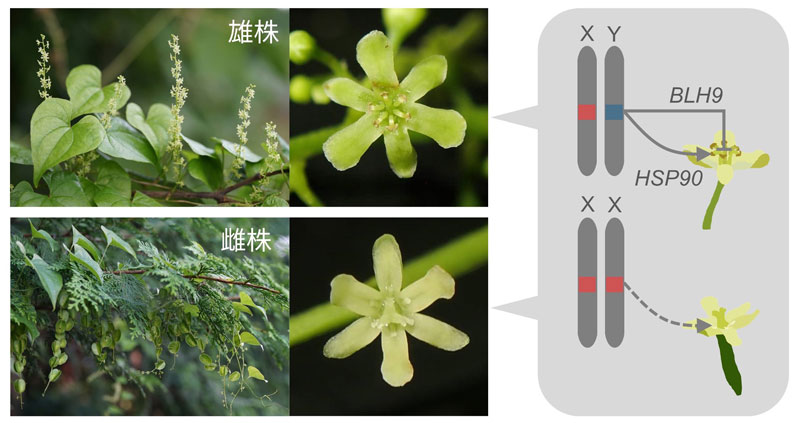
野生植物オニドコロにおける性決定機構。ゲノム解析によりXY性決定型であり、Y染色体上の2つの遺伝子、BLH9とHSP90が、雄花の形成に関与していると考えられた。オニドコロではこれら2つの遺伝子があるY染色体をもつ個体(XY)は雄株になり、Y染色体をもたない個体(XX)が雌株になる仕組みがあると考えられた。作成:工藤葵
<関連情報>
- https://www.kyoto-u.ac.jp/ja/research-news/2026-04-28-2
- https://journals.plos.org/plosgenetics/article?id=10.1371/journal.pgen.1012123
全ゲノムシーケンスによる雌雄異株性の野生植物オニドコロにおける性決定分子基盤の解明Whole-genome sequencing reveals a possible molecular basis of sex determination in the dioecious wild yam Dioscorea tokoro
Aoi Kudoh,Satoshi Natsume,Yu Sugihara,Hiroaki Kato,Akira Abe,Kaori Oikawa,Motoki Shimizu,Kazue Itoh,Mai Tsujimura,Yoshitaka Takano,Toshiyuki Sakai,Hiroaki Adachi,Atsushi Ohta, [ … ],Ryohei Terauchi
PLOS Genetics Published: April 20, 2026
DOI:https://doi.org/10.1371/journal.pgen.1012123
Abstract
Dioecious plants, which have distinct male and female individuals, constitute ~5% of angiosperm species and have emerged frequently and independently from hermaphroditic ancestors. Although recent molecular studies of sex determination have started to reveal the diversity of the genetic systems underlying dioecy, research on the evolution of dioecy is limited, especially in monocots. Here, we explore the molecular basis of sex determination in the monocot Dioscorea tokoro, a dioecious wild yam endemic to East Asia. Chromosome-scale and haplotype-resolved genome assemblies and linkage analysis suggested that this plant has a male heterogametic sex-determination (XY) system, with sex-determination regions located on chromosome 3. Sequence comparison between the X- and Y-chromosomes and read coverage analysis revealed X- and Y-specific regions in putative pericentromeric chromosome regions. Within the Y-specific region, we propose two candidate genes that are likely involved in sex determination: BLH9, encoding a homeobox protein, and HSP90, encoding a molecular chaperone. BLH9 functions in a similar way as AtBLH9 in Arabidopsis thaliana. BLH9 could be involved in suppression of female organ development, whereas HSP90 might be required for pollen development. These results shed light on the complex evolution of dioecy in plants.
Author summary
Sexual reproduction is a nearly universal, indispensable feature of evolution in eukaryotes. The molecular mechanisms underlying sex determination vary depending on the taxon. However, most information about this process was derived from studies of model organisms and/or domesticated species. To elucidate the diversity and evolution of sex determination, we need to expand the taxonomic breadth of these investigations. Here, we focus on the monocot genus Dioscorea, which contains species with multiple sex-determination systems, suggesting that frequent evolutionary transitions occur between them. We investigated the genetics of sex determination in Dioscorea tokoro, a dioecious wild yam endemic to East Asia. Whole-genome assembly and genetic analysis, along with transcriptome analysis, suggested that this species follows a male heterogametic sex-determination (XY) system, with two Y chromosome–specific genes that might be involved in male and female differentiation. These findings enhance our understanding of the complex evolution of dioecy.