2026-09-02 国立成育医療研究センター
<関連情報>
- https://www.ncchd.go.jp/press/2026/0902.html
- https://link.springer.com/article/10.1186/s13287-026-05249-1
造血ニッチとT細胞支持ニッチを統合したヒトiPSC由来骨髄オルガノイド Human iPSC-derived bone marrow organoids with integrated hematopoietic and T cell-supportive niches
Jiyoung Lee,Tomoyuki Kawasaki,Lilika Tabata,Junlong Chen,Toru Uchiyama,Satoshi Yamazaki,Akihiro Umezawa & Hidenori Akutsu
Stem Cell Research & Therapy Published:19 August 2026
DOI:https://doi.org/10.1186/s13287-026-05249-1
Abstract
Background
The anatomical separation of bone marrow and thymus limits the efficient generation of human immune cells in vitro and constrains experimental platforms for modeling integrated hematopoiesis. We investigated whether a synthetic human bone marrow could be engineered to support both hematopoietic and T-lineage-associated functions.
Methods
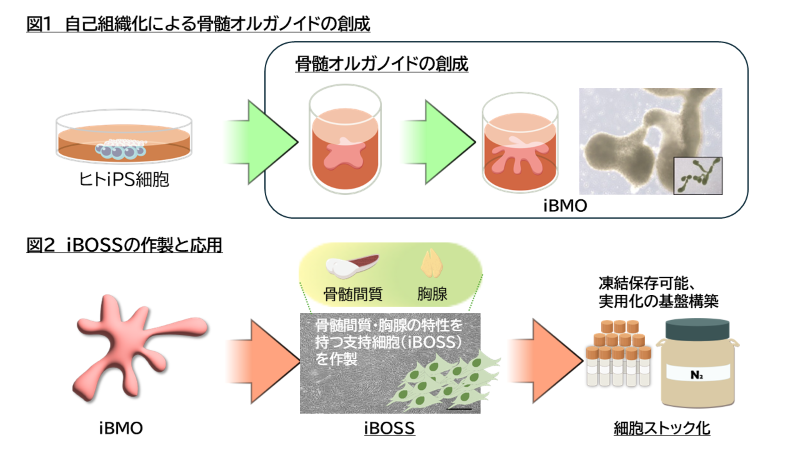
We generated human induced pluripotent stem cell-derived bone marrow organoids (iBMOs) that self-organize into stromal, vascular, and hematopoietic compartments and provide microenvironmental cues supportive of T cell differentiation.
Results
iBMOs produced hematopoietic progenitors and yielded stable stromal stem cell lines (iBOSS) that expressed Notch-associated molecules and supported the differentiation of iPSC-derived hematopoietic progenitors toward T-lineage and dendritic cell-associated populations in vitro. Following transplantation into immunodeficient mice, iBMOs sustained human erythropoiesis and underwent bone formation, demonstrating autonomous niche activity in vivo.
Conclusion
This integrated bone marrow organoid platform provides a physiologically relevant system for studying human hematopoietic development and immune cell differentiation and offers a scalable foundation for regenerative medicine and immunotherapy applications.