2026-09-01 アニコム先進医療研究所株式会社,麻布大学,京都大学
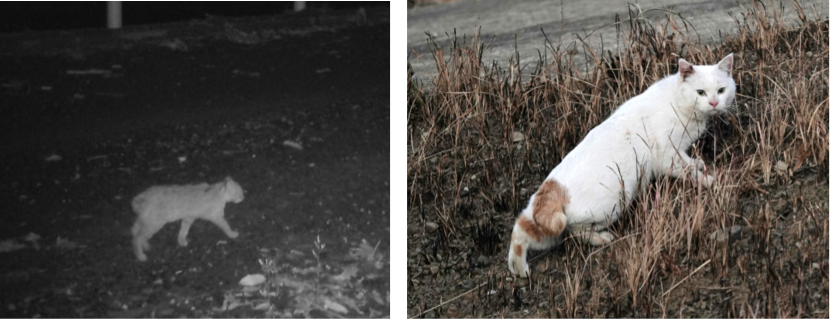
対馬で撮影された短尾のツシマヤマネコ(左)と短尾のイエネコ(右)
<関連情報>
- https://www.anicom-med.co.jp/news/20260901.html
- https://www.sciencedirect.com/science/article/pii/S235198942600315X
絶滅が危惧されるツシマヤマネコにおけるイエネコからの遺伝子浸透の疑いに関する全ゲノム規模の検証 Genome-wide assessment of suspected domestic cat introgression in the critically endangered Tsushima leopard cat
Yuki Matsumoto, Takuma Kaito, Koki Taniguchi, Daijiro Hata, Ryotaro Kaneko, Yui Habe, Keisuke Matsushita, Noriyoshi Akiyama, Yushi Koshida, Takae Shimizu-Matsumoto, Miho Inoue-Murayama, Hideyuki Ito
Global Ecology and Conservation Available online: 5 August 2026
DOI:https://doi.org/10.1016/j.gecco.2026.e04365
Abstract
The Tsushima leopard cat, an insular felid endemic to the Tsushima Island, Japan, is listed as Critically Endangered in the Japanese Red List, with an estimated population size of approximately 100 individuals. Recently, a short-tailed individual was detected, raising concerns over its possible hybrid origins because such a phenotype has not been documented in leopard cats but is relatively common in domestic cats. However, whether this phenotype reflects domestic introgression or variation within the wild population remains unknown. We hypothesized that recent introgression would produce a detectable domestic ancestry signal in the focal individual. We therefore analyzed whole-genome data from the focal individual, 15 additional Tsushima leopard cats, five domestic cats from Tsushima Island, and four Amur leopard cats as continental wild references. Principal component analysis placed the focal individual within the Tsushima leopard cat cluster. ADMIXTURE assigned the focal individual almost entirely to the Tsushima leopard cat ancestry component, and neither f3 nor f4 admixture statistics supported recent domestic cat introgression. Mitochondrial DNA analysis showed that the focal individual shared a haplotype with the Tsushima leopard cats and was distinct from the domestic cat clade. The same genetic pattern was observed across the sampled population, with no evidence of substantial recent hybridization in the focal individual or nearby wildcats. To the best of our knowledge, this is the first report of a short-tailed individual in the genus Prionailurus. These findings highlight the value of genome-wide evaluation in resolving suspected hybrid cases in endangered wild felids.