2026-08-31 中国科学院(CAS)
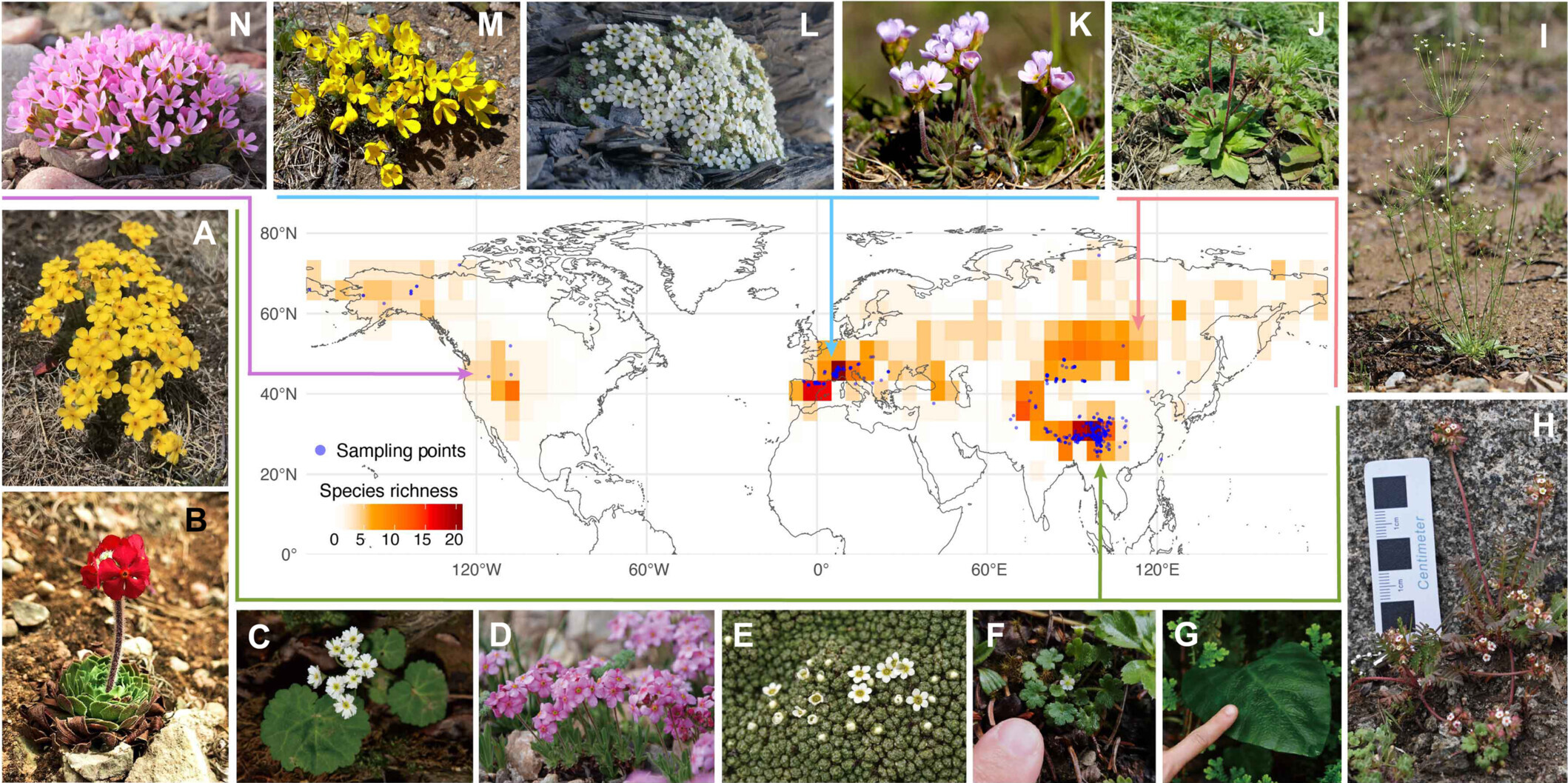
Species richness, sample distribution, and representative species of Androsace (Image by XTBG)
<関連情報>
- https://english.cas.cn/newsroom/research-news/202609/t20260901_1189538.shtml
- https://onlinelibrary.wiley.com/doi/10.1111/jse.70099
北半球におけるサクラソウ科(Androsace sl .)のマクロ進化ダイナミクス Macroevolutionary dynamics of Androsace s.l. (Primulaceae) across the Northern Hemisphere
Chuan Peng, Chihchieh Yu, Wenna Ding, Liqiong Chen, Qiuyue Zhang, Yaoke Li, Florian C. Boucher, Sébastien Lavergne, Yaowu Xing
Journal of Systematics and Evolution Published: 13 August 2026
DOI:https://doi.org/10.1111/jse.70099
Abstract
Mountain regions of the Northern Hemisphere harbor exceptional biodiversity, yet the processes underlying species diversification and migration among these regions remain poorly understood. This study investigates the macroevolutionary dynamics of Androsace s.l., a genus widely distributed across temperate regions of the Northern Hemisphere, with notable diversity in the Alps and the Hengduan–Himalaya regions. Although previous phylogenetic studies have advanced understanding of the evolutionary history of Androsace, its biogeographic origins and diversification history have remained unresolved due to limited species sampling and low statistical support. Here, we revisited the inter- and infrageneric taxonomic controversies. Using chloroplast genome (cpDNA) and nuclear ribosomal ITS (nrDNA) sequences from 101 species representing four related genera and seven infrageneric sections, we reconstructed the most comprehensively sampled phylogeny of Androsace to date and established a spatiotemporal framework for its biogeographic and diversification history. Phylogenetic analyses based on cpDNA revealed four well-supported clades corresponding to distinct ecological, geographic, and morphological traits. A similar four-clade structure was recovered in the ITS phylogeny, albeit with lower statistical support. Divergence time estimation and biogeographic analyses traced the origin of Androsace s.l. to the Pan-Tibetan Highlands in the early Oligocene (~33 Ma), identifying this region as the source for other mountain systems. The genus underwent asynchronous diversification across different mountain systems and clades, driven by distinct tectonic events, environmental changes, and trait innovations. These results provide a spatiotemporal framework for understanding the evolution of alpine plants in the Northern Hemisphere.