2026-07-02 東京大学
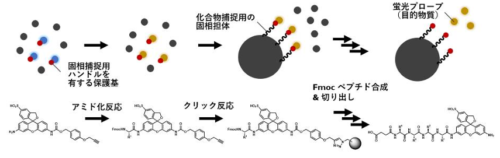
今回開発したSCCR法による蛍光プローブの合成例。上:SCCR法における合成の流れ、下:SCCR法を用いた蛍光プローブ合成スキームの例。
<関連情報>
- https://www.u-tokyo.ac.jp/focus/ja/press/z0111_00083.html
- https://www.u-tokyo.ac.jp/content/400291131.pdf
- https://pubs.acs.org/doi/10.1021/acscentsci.6c00783
共有結合による捕捉と放出に基づく合成により、精製不要の蛍光プローブライブラリーが実現し、単一分子プロテアーゼ活性プロファイリングが可能になる Synthesis Based on Covalent Capture and Release Enables Purification-free Fluorogenic Probe Libraries for Single-Molecule Protease Activity Profiling
Mayano Minoda,Tadahaya Mizuno,Takumi Iwasaka,Hiroyuki Kusuhara,Yu Kagami,Shingo Sakamoto,Norimichi Nagano,Chiaki Hori,Kazufumi Honda,Yasuteru Urano,and Toru Komatsu
ACS Central Science Published June 29, 2026
DOI:https://doi.org/10.1021/acscentsci.6c00783
Abstract
Direct measurement of enzyme activities provides functional insights into complex biological systems; however, their broader application is limited by the lack of scalable strategies to generate diverse, assay-ready fluorogenic probes. In particular, conventional probe synthesis relies on chromatographic purification, preventing the rapid and parallel exploration of substrate space at the library scale. Here, we report synthesis based on covalent capture and release (SCCR), a general chemical strategy that enables purification-free generation of fluorogenic probe libraries. By embedding a covalent capture handle within a removable protecting group, SCCR establishes a standardized capture–elongation–release workflow that decouples molecular diversification from chromatographic purification while retaining the flexibility of liquid-phase synthesis. This approach enables automated preparation of high-purity probe libraries compatible with sensitive activity assays. Using this platform, we generated a library of over 100 fluorogenic probes and applied it to profile protease activities at the single-molecule level, enabling substrate discovery and the activity-based identification of disease-associated enzymatic signatures in blood samples. These results establish a scalable route to functional probe generation and expand the accessible space for single-molecule enzyme activity profiling in complex biological systems.