2026-07-02 大阪大学
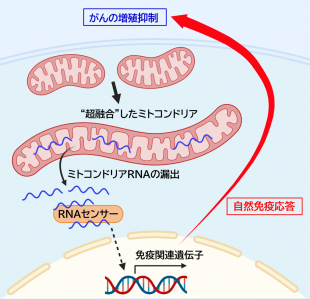
ミトコンドリアの超融合が免疫反応を引き起こす
<関連情報>
- https://www.sci.osaka-u.ac.jp/ja/topics/16849/
- https://www.sci.osaka-u.ac.jp/ja/wp-content/uploads/2020/08/pr_ishihara20260702.pdf
- https://www.cell.com/cell-reports/fulltext/S2211-1247(26)00685-6
ミトコンドリアの動態異常は、ミトコンドリアRNAの放出を介してRNA感知型自然免疫を活性化する Disrupted mitochondrial dynamics activate RNA-sensing innate immunity through mitochondrial RNA release
Tatsuki Yasuda ∙ Aoi Ichikawa ∙ Kenta Onoue ∙ … ∙ Takaya Ishihara ∙ Hidetaka Kosako ∙ Naotada Ishihara
Cell Reports Published:June 26, 2026
DOI:https://doi.org/10.1016/j.celrep.2026.117607
Highlights
- Mitochondrial hyperfusion promotes cytosolic mitochondrial RNA release
- Released mtRNA activates RIG-I-MAVS-dependent innate immunity
- BAX contributes to hyperfusion-induced innate immune signaling
- Hyperfusion enhances NK cell sensitivity and suppresses tumor growth
Summary
Mitochondria are dynamic organelles that continuously remodel their morphology through fusion and fission in response to cellular cues. While this dynamic behavior is essential for diverse cellular functions, how mitochondrial dynamics influence innate immune responses remains incompletely understood. Here, we show that mitochondrial hyperfusion—induced by loss of the fission factor DRP1 or by cellular stress, including cycloheximide or doxorubicin treatment—is associated with activation of a RIG-I-MAVS-dependent innate immune response and BAX-dependent cytosolic release of mitochondrial RNA. Functionally, our data suggest that this pathway contributes to enhanced susceptibility to NK cell-mediated cytotoxicity in vitro and reduced tumor growth in a xenograft model. Collectively, our findings identify mitochondrial hyperfusion-induced mtRNA release as a mechanism that engages innate immune signaling downstream of impaired mitochondrial dynamics.