2026-07-01 東京大学
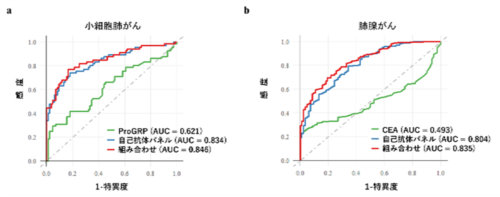
自己抗体パネルの診断性能
<関連情報>
- https://www.k.u-tokyo.ac.jp/information/category/press/0030168.html
- https://www.nature.com/articles/s41416-026-03504-z
小細胞肺癌および肺腺癌の診断と予後予測のための循環腫瘍関連自己抗体シグネチャー Circulating tumor-associated autoantibody signatures for diagnosis and prognosis in small-cell lung cancer and lung adenocarcinoma
Chaoqi Liu,Eriko Fukuda,Yoji Sagiya,Hiromi Tsuru,Yuka Okamoto,Takayuki Morisaki,Yoichiro Kamatani,Yukinori Okada,Yutaka Suzuki,Akinori Kanai,Naoki Goshima,Chizu Tanikawa,Koichi Matsuda & the BioBank Japan Project
British Journal of Cancer Published:25 June 2026
DOI:https://doi.org/10.1038/s41416-026-03504-z
Abstract
Background
Tumour-associated autoantibodies (TAAbs) are promising biomarkers for cancer detection, but their induction and clinical relevance in lung cancer remain unclear.
Methods
Serum samples from 695 individuals were analysed for TAAb profiling by protein-array screening and two-stage ELISA validation. Diagnostic models were constructed with identified TAAbs and compared with conventional tumour markers. Potential mechanisms, clinical and prognostic features of TAAb seropositivity were analysed and its presence in prediagnostic sera was evaluated to assess the potential for early detection.
Results
Six TAAbs for small cell lung cancer (SCLC) and four for lung adenocarcinoma (LUAD) were identified, demonstrating excellent diagnostic performance (AUC > 0.8) and outperforming ProGRP and CEA. TAAb induction correlated with antigen overexpression, somatic mutations and HLA class II amino acid polymorphisms. TAAb panel seropositivity was associated with older age and advanced stage in both subtypes, and predicted poor survival in SCLC but a favourable outcome in advanced LUAD. In prediagnostic sera, the TAAb concentration increased progressively, with detectability up to 2 years before clinical diagnosis.
Conclusions
Distinct TAAb panels were identified for SCLC and LUAD, serving as accurate diagnostic markers that enable early detection and as indicators of prognosis in different clinical contexts.