2026-07-08 ロイヤルメルボルン工科大学(RMIT)
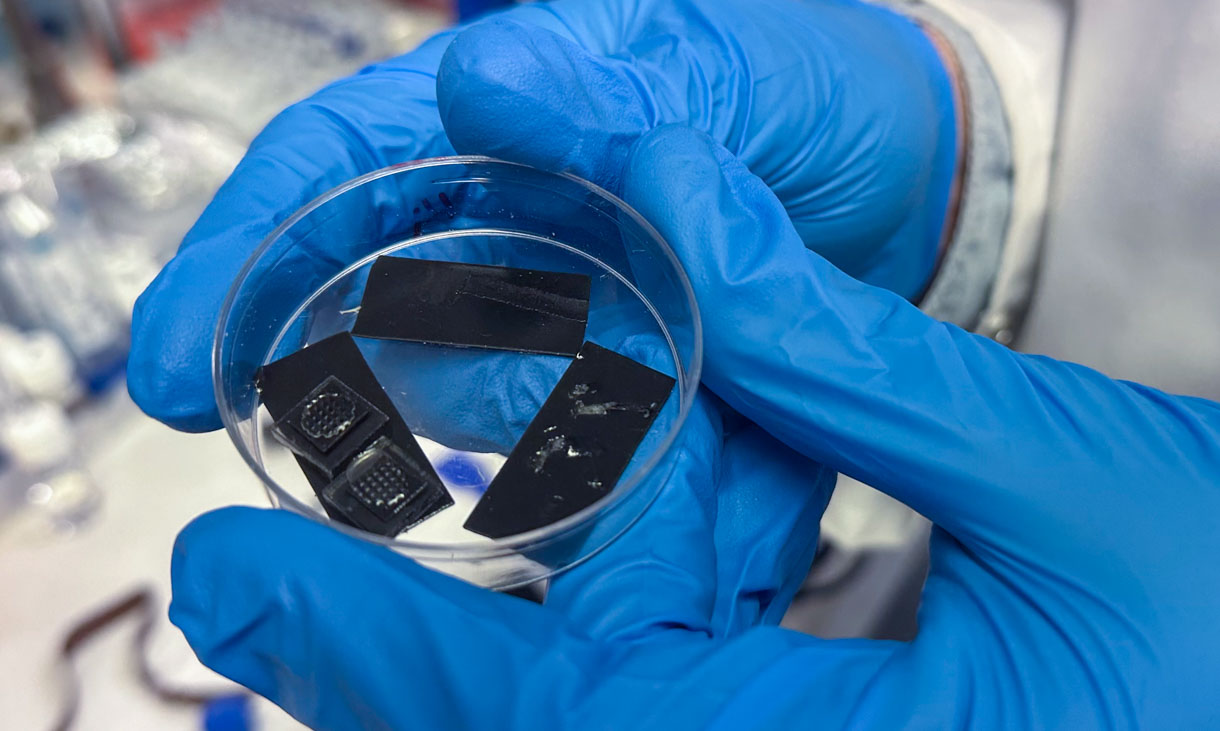
Microneedle patches. Image: Cherry Cai, RMIT
<関連情報>
- https://www.rmit.edu.au/news/all-news/2026/jul/vaccine-patches
- https://advanced.onlinelibrary.wiley.com/doi/10.1002/adfm.75716
mRNAワクチンの低温保存に代わる方法の検討:ポリマーマトリックス中で乾燥させた際のmRNA-脂質ナノ粒子の安定性 Exploring an Alternative to mRNA Vaccine Cold Chain Storage: MRNA-Lipid Nanoparticle Stability When Dried in a Polymer Matrix
Brendan P. Dyett, Shahad K. Alsaiari, John L. Daristotle, Timothy A. Forster, Alicia Lau, Dhruv Varshney, Rania Afaneh, Andrew R. Hanna, Charles Sloane, David Mankus, Haitao Yu, Jiali Zhai, …
Advanced Functional Materials Published: 07 May 2026
DOI:https://doi.org/10.1002/adfm.75716
ABSTRACT
Cold chain storage requirements limit the accessibility of mRNA vaccines and therapeutics more broadly within the developing world. Polymer microneedles are a promising alternative for overcoming challenges associated with cold chain distribution and vaccine storage, and have additional advantages in ease of application. Herein, we reveal the structural transformations and performance of mRNA-loaded lipid nanoparticles (LNPs) during dehydration and rehydration within the polymer framework (PVPVA) employed for microneedle fabrication. Cryogenic transmission electron microscopy and in situ small-angle x-ray scattering revealed that the LNPs display partial inverse hexagonal packing of the self-assembled lipid molecules, which can be recovered upon rehydration with sufficient polymer loading (polymer:mRNA > 320:1). The performance of the recovered LNPs is sensitive to polymer loading, and at low polymer loading (polymer:mRNA 32:1), the LNPs are unstable. LNPs of higher N/P ratios (mole ratio of protonatable amines to mole of phosphate groups from mRNA) were more robust to recovery due to improved mRNA encapsulation efficiency (∼20%–80%) and potentially lower loss of mRNA-loaded carriers during processing (∼3-fold lower coalescence signal). Balancing the polymer and mRNA loading yielded a 100-fold increase in transfection for the optimized 5.4 N/P ratio Lipid-5 system.