2026-07-10 順天堂大学
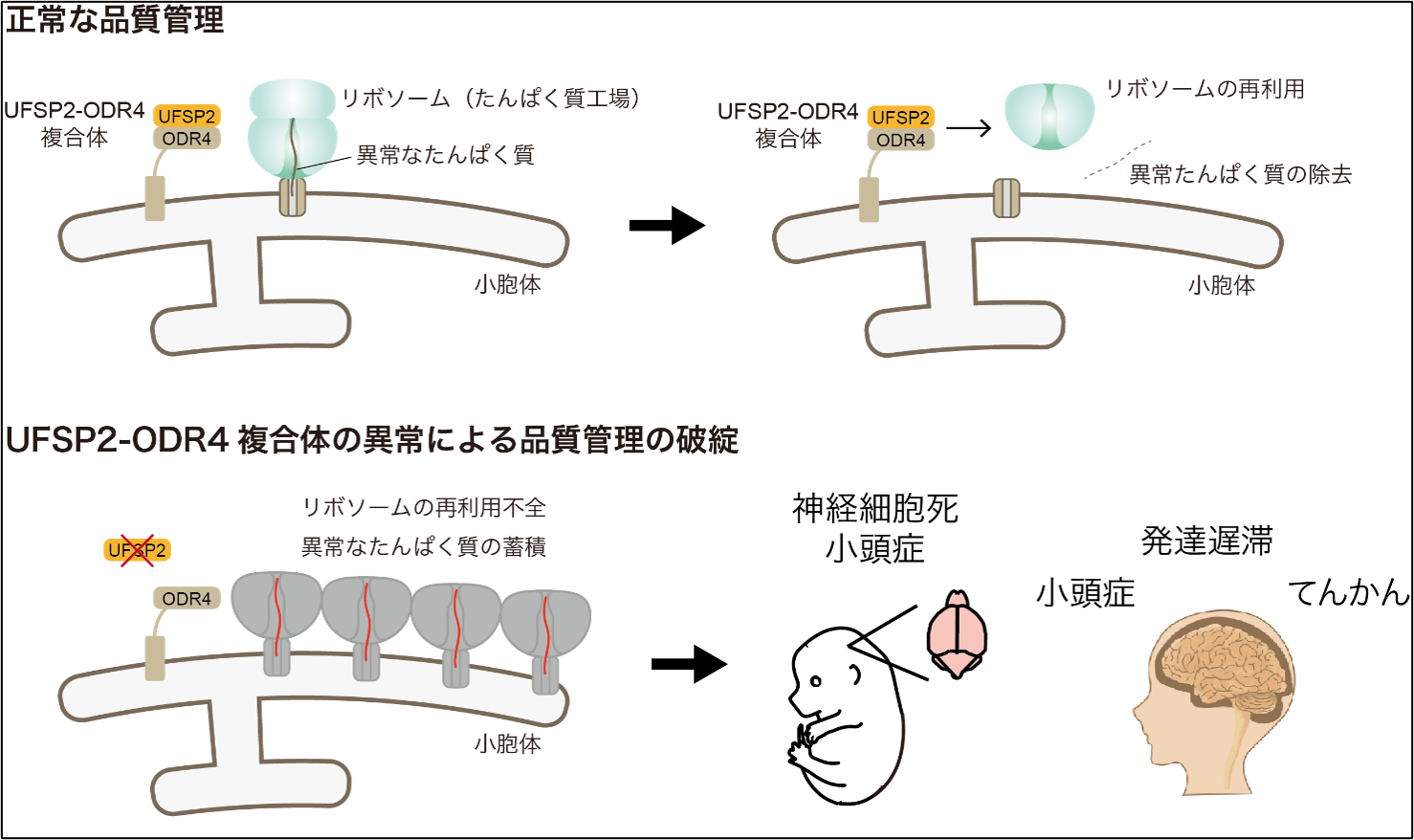
図1:本研究で明らかになったたんぱく質工場の品質管理メカニズム
<関連情報>
- https://www.juntendo.ac.jp/news/27749.html
- https://www.sciencedirect.com/science/article/abs/pii/S1097276526004156
UFSP2–ODR4酵素複合体によるUFM1脱修飾の空間制御機構の解明と神経細胞プロテオスタシス維持における役割 The UFSP2-ODR4 complex spatially confines and dynamically controls UFM1 deconjugation to safeguard neuronal proteostasis
Gaoxin Mao, Sota Ito, Ryosuke Ishimura, Jun-ichi Sakamaki, Ryohei Sasaki, Takefumi Uemura, Kei-Ichi Ishikawa, Satoko Komatsu-Hirota, Wado Akamatsu, Manabu Abe, Satoshi Waguri, Sunita Bijarnia-Mahay, Nobuo N. Noda, Toshifumi Inada, Masaaki Komatsu
Molecular Cell Available online: 9 July 2026
DOI:https://doi.org/10.1016/j.molcel.2026.06.026
Summary
The ubiquitin-fold modifier 1 (UFM1) pathway is essential for endoplasmic-reticulum-associated ribosome quality control (ER-RQC) through UFMylation of the 60S ribosomal protein RPL26, but the regulation and physiological significance of UFM1 deconjugation remain poorly understood. Here, we identify the ER-anchored UFSP2-ODR4 complex as a spatially confined deUFMylation module critical for neuronal proteostasis. Structural modeling and biochemical analyses show that ODR4 recruits UFSP2 to the ER, enabling efficient deUFMylation of RPL26. Disruption of the UFSP2-ODR4 interaction causes the accumulation of UFMylated RPL26 and defective ER-RQC. Neural progenitor-specific knockin mice expressing a catalytically inactive UFSP2 mutant exhibit perinatal lethality, microcephaly, and neuronal apoptosis. We also identify a patient with biallelic UFC1 mutations that enhance UFL1 binding and induce hyper-UFMylation of RPL26 in patient-derived neurons. These findings establish spatially confined deUFMylation as a critical mechanism for safeguarding neuronal proteostasis.