2026-05-20 ミュンヘン大学(LMU)
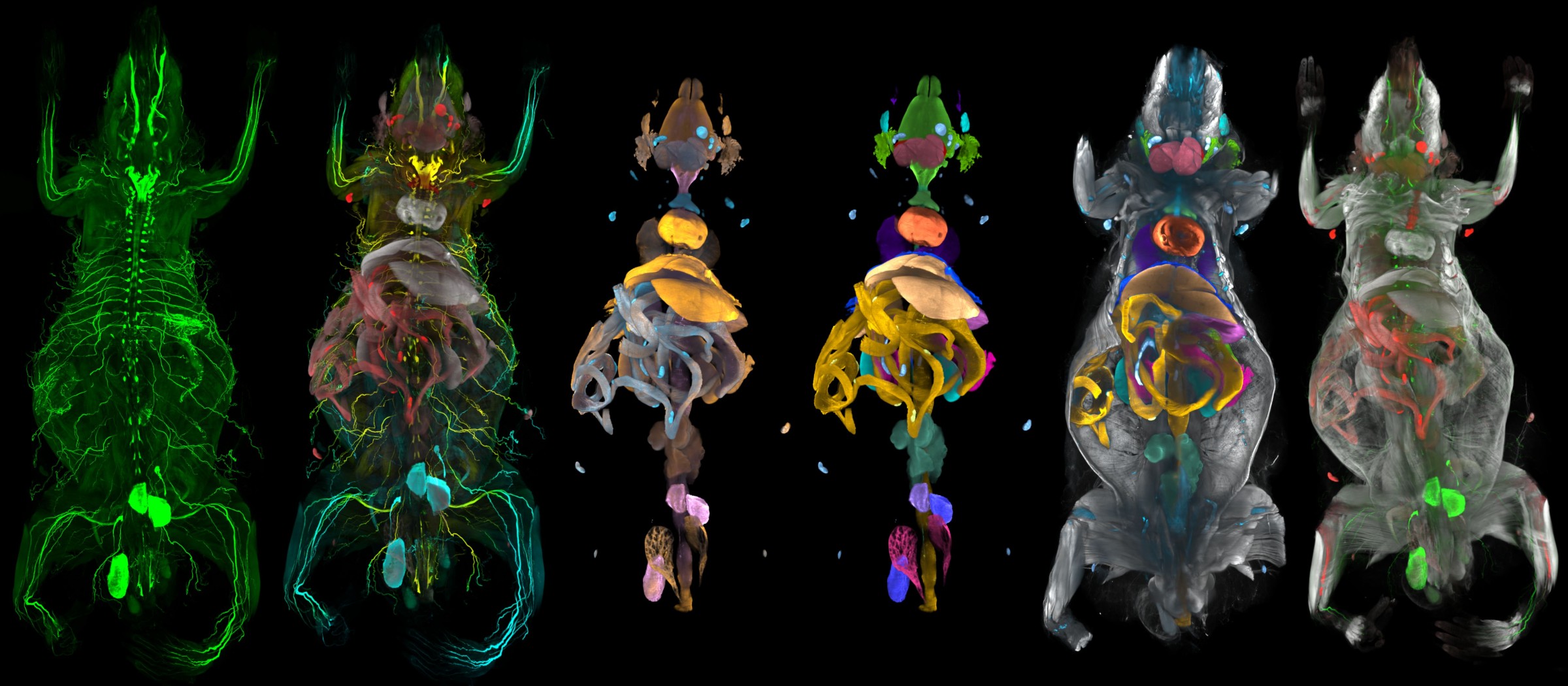
Whole-Body Analysis
MouseMapper automatically segments 31 organs and tissue types in a mouse while simultaneously mapping neural and immune cells throughout the body. This enables comprehensive multi-organ analyses in intact mice.© Ertürk Lab | Helmholtz Munich
<関連情報>
- https://www.lmu.de/en/newsroom/news-overview/news/artificial-intelligence-analyzes-whole-mouse-bodies-down-to-cell-level-48670c94.html
- https://www.nature.com/articles/s41586-026-10535-2
深層学習フレームワークにより、細胞レベルでの全身的な摂動が明らかになる A deep-learning framework reveals whole-body perturbations at cell level
Doris Kaltenecker,Izabela Horvath,Rami Al-Maskari,Ying Chen,Zeynep Ilgin Kolabas,Luciano Hoeher,Mihail Todorov,David-Paul Minde,Saketh Kapoor,Sena Gül Turhan,Louis B. Kuemmerle,Hanno Steinke,Tim Wohlgemuth,Mayar Ali,Florian Kofler,Pauline Morigny,Julia Geppert,Denise Jeridi,Bastian Wittmann,Jie Luo,Suprosanna Shit,Carolina Cigankova,Victor Miro Kolenic,Nilsu Gür,… Ali Ertürk
Nature Published:20 May 2026
DOI:https://doi.org/10.1038/s41586-026-10535-2
Abstract
Many diseases, including obesity, have systemic effects that perturb multiple organ systems throughout the body1,2. However, tools for comprehensive, high-resolution analysis of disease-associated changes at the whole-body scale have been lacking. Here we developed MouseMapper, a suite of foundation-model-based deep-learning algorithms enabling multi-system analysis of disease across the entire mouse body. MouseMapper enables whole-body quantitative analysis of nerves and immune cells, resolving fine axonal branches and immune-cell clusters while automatically segmenting 31 organs and tissues. We used MouseMapper to study diet-induced obesity, and identified structural alterations of the infraorbital branch of the trigeminal ganglia. This structural impairment in infraorbital nerves was associated with functional sensory deficits in whisker sensing. Furthermore, we identified proteomic changes in the trigeminal ganglion affecting axon remodelling and complement pathways both in mice and humans. MouseMapper also generated detailed three-dimensional inflammation maps by characterizing immune cell cluster compositions across tissues. The MouseMapper framework demonstrates robust generalizability across different imaging resolutions and datasets. Our study provides a powerful, scalable approach for identifying and quantifying systemic pathologies, bridging molecular insights from animal models to human conditions.