2026-07-09 京都⼤学
(作成者:松浦 顕教)
<関連情報>
- https://www.kyoto-u.ac.jp/ja/research-news/2026-07-09-3
- https://www.cell.com/cell-reports/fulltext/S2211-1247(26)00708-4
分岐鎖アミノ酸への代謝依存性がヒトトリプルネガティブ乳がんのがん幹細胞性と悪性度を規定する Distinct metabolic dependency on BCAA defines cancer stemness and malignancy in human triple-negative breast cancer
Kenkyo Matsuura ∙ Ririko Shinonaga ∙ Mizuki Yamamoto ∙ … ∙ Ayuna Hattori ∙ Hiromi Imamura, ∙ Takahiro Ito
Cell Reports Published:July 8, 2026
DOI:https://doi.org/10.1016/j.celrep.2026.117630
Highlights
- Claudin-low triple-negative breast cancer relies on branched-chain amino acids
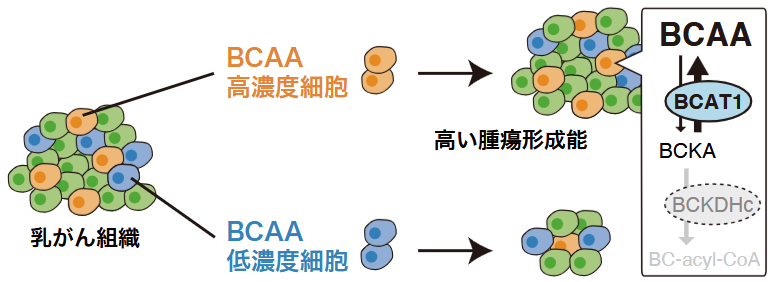
- Cancer stem cell potential is sustained by elevated intracellular branched-chain amino acids
- BCAT1 enzyme mediates branched-chain amino acid production and drives tumor growth
- The BCAT1-BCKDHc axis offers a therapeutic target in triple-negative breast cancer
Summary
Triple-negative breast cancer (TNBC) lacks effective molecularly targeted therapies. Here, we identify branched-chain amino acid (BCAA) metabolism as a selective vulnerability in human TNBC, particularly in the claudin-low subtype. TNBC cells show greater dependence on BCAAs than other breast cancer subtypes, and intracellular BCAA levels are heterogeneous within tumors in vivo. Cells with high BCAA levels exhibit enhanced sphere formation and cancer stem cell potential in xenograft models. BCAT1, a cytoplasmic BCAA aminotransferase, is upregulated in claudin-low TNBC and enables tumor growth by promoting BCAA production from branched-chain ketoacids. BCAT1 knockdown impairs TNBC growth in vivo, and high BCAT1 expression predicts poor prognosis in patient cohorts. Conversely, BCAA catabolism via the BCKDH complex is suppressed in TNBC, and reactivation of BCKDH by BCKDK knockout blocks clonogenic growth. These findings reveal BCAA metabolic balance as a key regulator of TNBC stemness and malignancy.