
2026-07-15 コロンビア大学
<関連情報>
- https://zuckermaninstitute.columbia.edu/upending-decades-debate-scientists-discover-most-neurons-are-jacks-all-trades
- https://www.nature.com/articles/s41586-026-10668-4
皮質階層に沿った、まれにしか分類されない、高度に分離可能な表現 Rarely categorical, highly separable representations along the cortical hierarchy
Lorenzo Posani,Shuqi Wang,Samuel P. Muscinelli,Liam Paninski & Stefano Fusi
Nature Published:15 July 2026
DOI:https://doi.org/10.1038/s41586-026-10668-4
Abstract
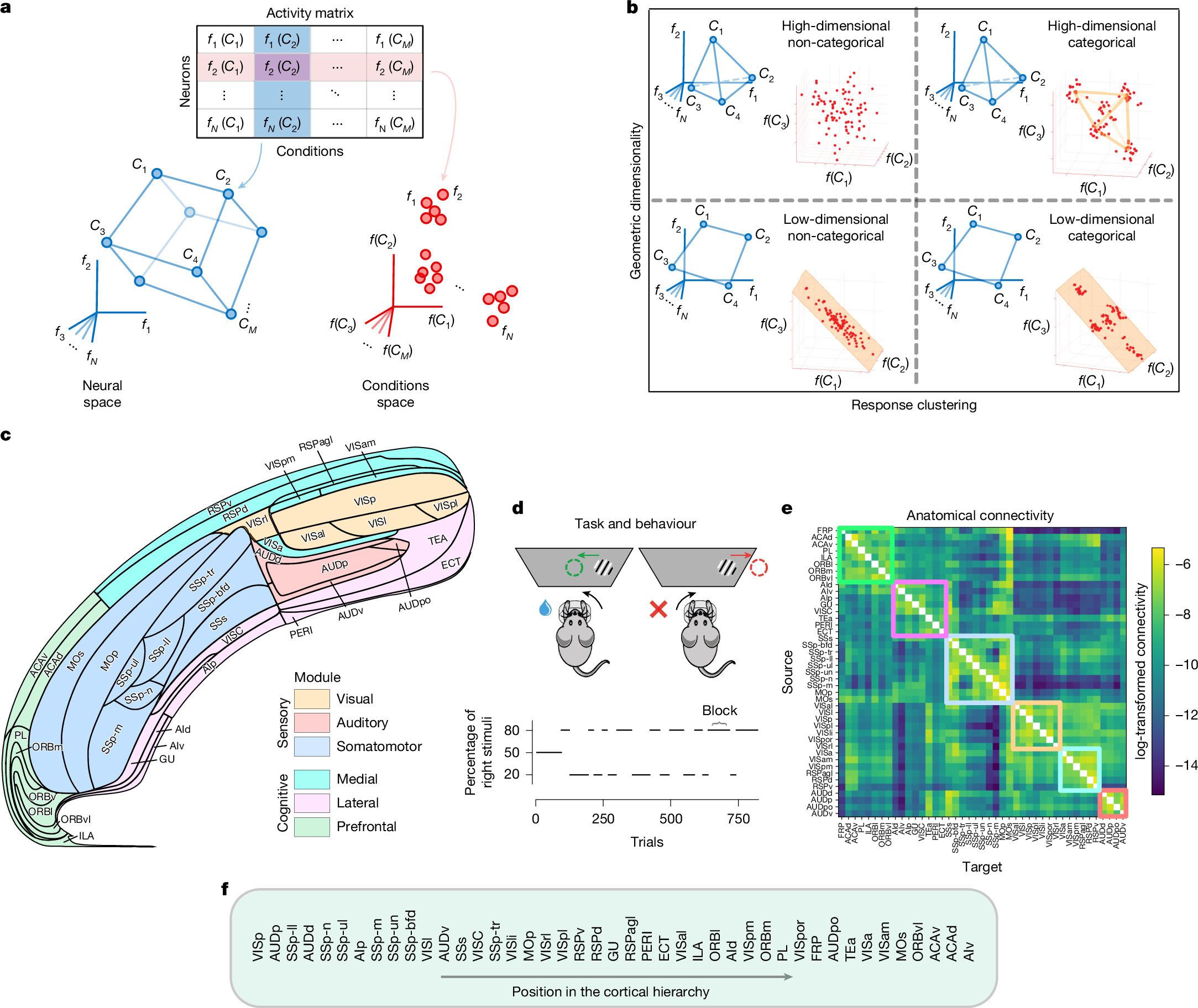
A long-standing debate in neuroscience concerns whether individual neurons are organized into functionally distinct populations that encode information differently (categorical representations1,2,3) and the implications for neural computation. Here we systematically analysed how cortical neurons encode cognitive, sensory and movement variables across 43 cortical regions during a complex task (14,000+ units from the International Brain Laboratory public Brainwide Map dataset4) and studied how these properties change across the sensory–cognitive cortical hierarchy5. We found that the structure of the neural code was scale dependent. At the whole-cortex scale, neural selectivity was categorical and organized across regions in a way that reflected their anatomical connectivity. However, within individual regions, categorical representations were rare and limited to primary sensory areas, and neuronal responses were instead very diverse. With theoretical arguments and empirical evidence, we demonstrate that the diversity of neural responses enables high-dimensional representations and therefore high separability, allowing linear readouts to separate experimental conditions in many arbitrary ways. Indeed, when accounting for information that is actually encoded in each area, all cortical regions exhibit maximal separability. Our results indicate that cortical circuits prioritize diversity over categorical structure, supporting a computational regime geared towards high-dimensional, highly separable neural representations.

