2026-07-16 ワシントン大学セントルイス校
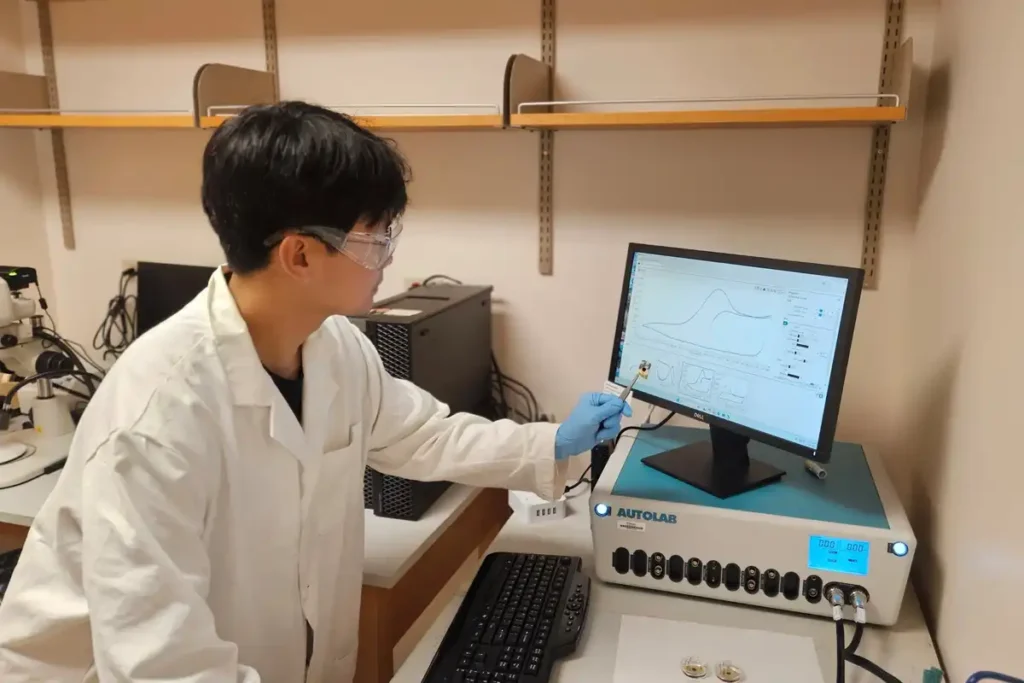
Engineering doctoral student Jae Park has developed a unique dynamic platform with electricity-conducting biomaterials in which stiffness can be modulated. The platform can help researchers study the effect of stiff environments on cells, which play a role in fibrosis and some cancers. (Photo courtesy of Jae Park)
<関連情報>
- https://source.washu.edu/2026/07/new-tool-to-help-research-fibrosis-cancer/
- https://advanced.onlinelibrary.wiley.com/doi/10.1002/adfm.76262
PEDOTの特性評価:剛性の電子制御のためのPSS Characterizing PEDOT: PSS for Electronic Control of Stiffness
Jae Park, Tianran Liu, Somtochukwu S. Okafor, Anna P. Goestenkors, Barbara A. Semar, Sandra K. Montgomery, Scott T. Keene, Alexandra L. Rutz
Advanced Functional Materials Published: 01 June 2026
DOI:https://doi.org/10.1002/adfm.76262
ABSTRACT
Active stiffness, the changing of material stiffness in response to an external stimulus, can be harnessed for mechanically adaptive implantable devices and dynamic cell culture substrates for mechanobiology investigations. Conducting polymer (CP)-based materials are capable of changing stiffness in response to an applied electrical potential: redox-driven changes in charge state lead to ion transport and subsequent swelling. This phenomenon has been investigated for polymeric actuators but rarely for active stiffness. In this study, the stiffness of poly(3,4-ethylenedioxythiophene): poly(styrenesulfonate) (PEDOT: PSS) films as a function of applied potential is characterized. Electrochemical preconditioning is first defined, and the proportionality of ion transport to voltage is identified. The maximum stiffness change observed over the potential range was found to be ∼32.5%, and changes of ∼6.7%–10.4% were found with 0.2 V increments. PEDOT: PSS films deviate in both their charge state and stiffness over a period of many hours after unbiasing. After unbiasing, PEDOT: PSS loses the transported charge over time and the stiffness changes by ∼2.6%–15.2% over 24 h. Finally, as a first step to evaluate the feasibility for biomedical applications, the active stiffness modulation process is determined to be cytocompatible. These characterizations highlight both the potential of CPs for active stiffness and identify areas for future optimization.