2026-07-23 合肥物質科学研究院(HFIPS)
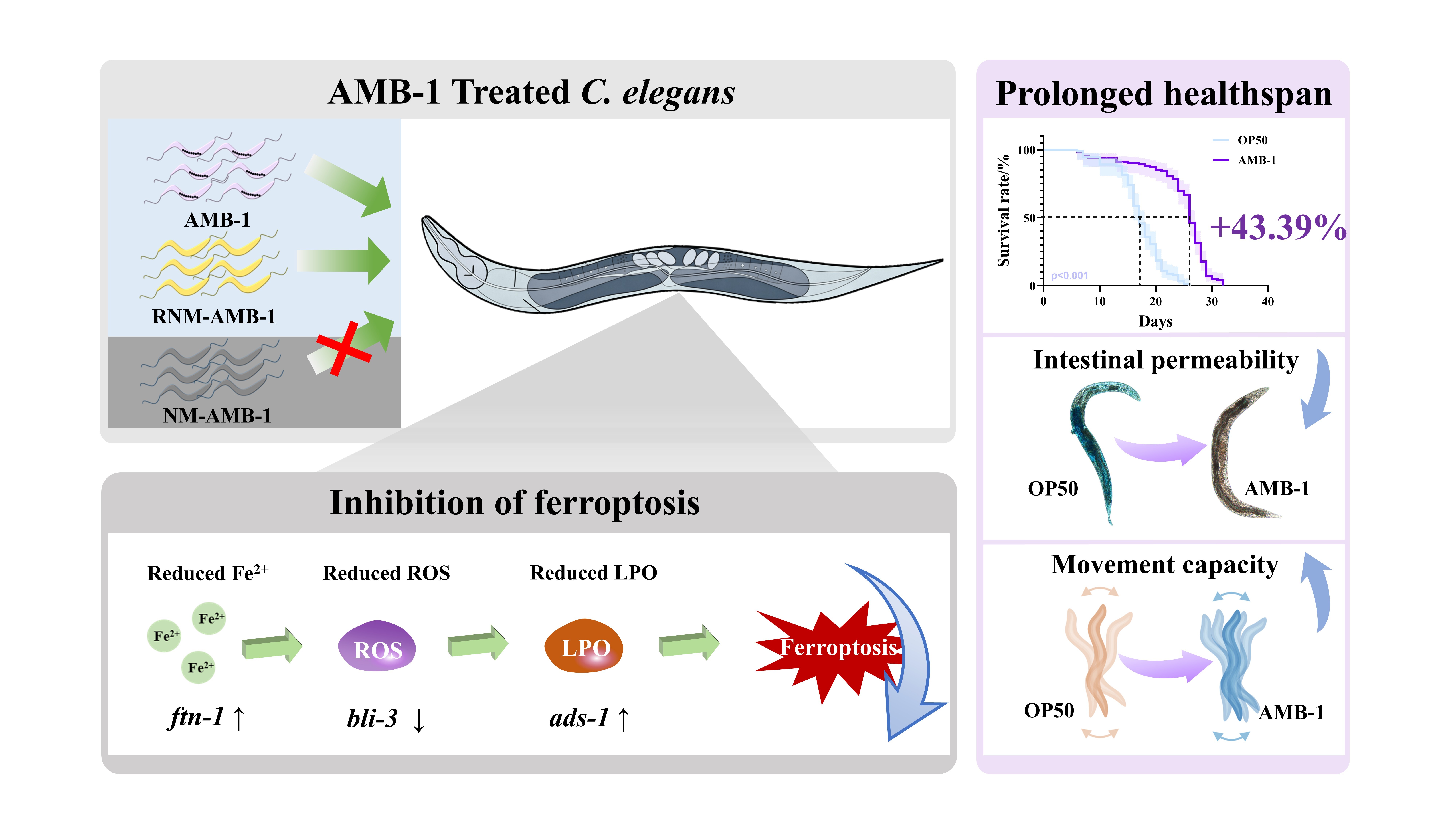
AMB-1 significantly extended the healthy lifespan of C. elegans by inhibiting ferroptosis. (Image by LIU Yun)
<関連情報>
- https://english.hf.cas.cn/nr/rn/202607/t20260723_1178948.html
- https://www.sciencedirect.com/science/article/abs/pii/S0891584926009056
磁性細菌の新たな役割:Magnetospirillum magneticum AMB-1は、フェロトーシスを制御することにより、線虫Caenorhabditis elegansの健康寿命を延長する A novel role for magnetotactic bacterium: Magnetospirillum magneticum AMB-1 prolonged healthy lifespan of Caenorhabditis elegans via regulating ferroptosis
Yuting Ding, Xinyao Huang, Yanan Zhao, Ruoyun Dong, Chenxi Zhou, Yuanyuan Wu, Hua Du, Juan Wan, Yun Liu, An Xu
Free Radical Biology and Medicine Available online: 26 June 2026
DOI:https://doi.org/10.1016/j.freeradbiomed.2026.06.050
Highlights
- AMB-1 can effectively extend the mean lifespan of C. elegans by 43.39 %.
- AMB-1 prolonged healthy lifespan by inhibiting ferroptosis in C. elegans.
- AMB-1 had potential applications in neurodegenerative diseases, such as PD and HD.
Abstract
Magnetotactic bacteria (MTB), which contain special nano-magnetic particles within their cells, have been extensively studied for biomedical applications including drug delivery and cancer treatment. However, the practical application of bacteria themselves remains relatively limited in current research. Magnetospirillum magneticum AMB-1 (AMB-1), an MTB capable of iron biomineralization and possessing potential antioxidant properties, was investigated in this study for its effects on lifespan and healthspan in Caenorhabditis elegans (C. elegans), as well as its underlying mechanisms. Our results showed that feeding with AMB-1 significantly extended the mean lifespan of C. elegans by 43.39 %, from 17.17 ± 1.25 to 24.62 ± 1.44 days. Moreover, AMB-1 improved neural function and preserved intestinal integrity in aged C. elegans, leading to a significant healthy lifespan extension. Further research found that AMB-1 treatment decreased Fe2+ content by 34.11 % and lipid peroxide levels by 52.19 %, compared to the OP50-fed control. Notably, AMB-1 administration markedly attenuated aging-associated ferroptosis. Specifically, AMB-1 upregulated the expression of ftn-1, which encodes ferritin, and downregulated bli-3, the sole NADPH oxidase (NOX) homolog that promotes ferroptosis in C. elegans, leading to suppression of ferroptosis-related indicators. RNA interference (RNAi) experiments revealed that the ferroptosis-related gene ads-1, encoding alkylglycerophosphate synthase (AGPS), played a critical role in AMB-1-induced longevity. These findings demonstrated that AMB-1 promoted healthy aging in C. elegans by inhibiting ferroptosis, highlighting its potential as an effective anti-aging microbial agent.