2026-07-27 北海道大学
<関連情報>
- https://www.hokudai.ac.jp/news/2026/07/post-2375.html
- https://journals.physiology.org/doi/full/10.1152/jn.00109.2026
個人の誤差応答に及ぼすチームの課題成績の影響 Influence of team task outcomes on individuals’ responses to their own errors
Naoyoshi Matsuda, Haruki Kayukawa, and Masaki O. Abe
Journal of Neurophysiology Published:Jun 8,2026
DOI:https://doi.org/10.1152/jn.00109.2026
Abstract
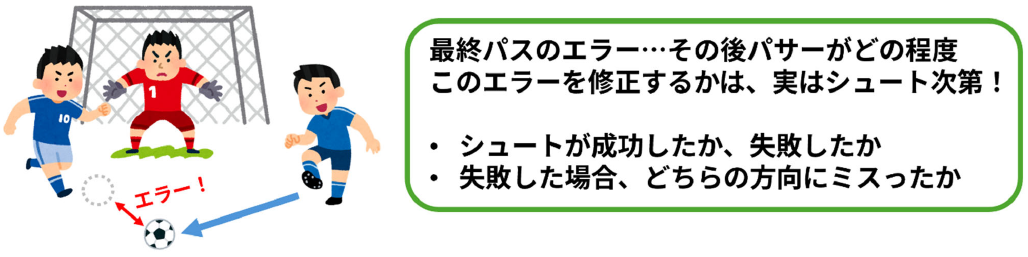
In team sports, the consequences of an individual’s action are often decoupled from the team task outcome because teammates can compensate for individual errors. Here, we asked whether in such cooperative contexts, an individual’s learning response to their own error is modulated by team outcome, even when their actions do not directly determine that outcome. We developed a joystick-based cooperative motor task that mimics a final pass and shot in soccer, performed by pairs of human participants (passer and shooter). In error-clamp trials, where the movements of both players did not influence the ball’s trajectory, the ball always deviated by ±6 cm from the pass target (pass error), and the shot either succeeded or failed, thereby defining team outcome. Trial-by-trial changes in the passer’s movement were the hallmark of error-based learning; movements in the subsequent trial shifted in the direction that compensated for the imposed error. Crucially, the passer’s learning response was smaller following success than failure, despite identical pass errors. Furthermore, the learning response was influenced by the directional relation between pass and shot errors. In the evaluation phase, participants judged visual consequences of either action by reporting where the ball crossed a reference line. They underestimated the error (the deviation between the ball and target), which was greater for partner-generated than self-generated errors. However, it was not significantly affected by team task outcomes. These findings suggest that team-level binary outcomes and final errors can modulate motor learning in individuals in a manner that appears dissociable from reportable error perception.
NEW & NOTEWORTHY Binary task outcomes influence error-based learning. Using a joystick-based dyadic task modeled on a soccer pass and shot, we showed that the passer’s learning response to their own pass error was reduced when team task outcome was successful (i.e., the shot was made). These findings indicate that team outcome can modulate individual error-based learning even when one’s action does not directly determine that outcome.