2026-08-07 国立健康危機管理研究機構,東海大学,東京大学
<関連情報>
- https://www.jihs.go.jp/content4/pressrelease/2026/20260806093625.html
- https://www.jihs.go.jp/content4/pressrelease/2026/2026020/20260807_1400.pdf
- https://journals.plos.org/plosntds/article?id=10.1371/journal.pntd.0014507
日本国内初の臨床分離株を用いたEntamoeba disparに対する腸管免疫応答の評価 Evaluation of intestinal immune responses to Entamoeba dispar using the first domestic clinical isolate in Japan
Yumiko Saito-Nakano,Akira Kawashima,Seiki Kobayashi,Koji Watanabe,Tetsuro Kawano-Sugaya,Shinji Izumiyama,Kumiko Nakada-Tsukui
PLOS Neglected Tropical Diseases Published: August 6, 2026
DOI:https://doi.org/10.1371/journal.pntd.0014507
Abstract
Background
Entamoeba dispar is a non-pathogenic sibling species of Entamoeba histolytica, yet the mechanisms that enable E. dispar to persist in the intestine without causing disease remain poorly understood. Experimental models for dissecting intestinal immune responses to E. dispar have been limited. In Japan and other East Asian countries, E. histolytica infection is relatively common among men who have sex with men, whereas E. dispar infection has rarely been identified.
Methodology/Principal findings
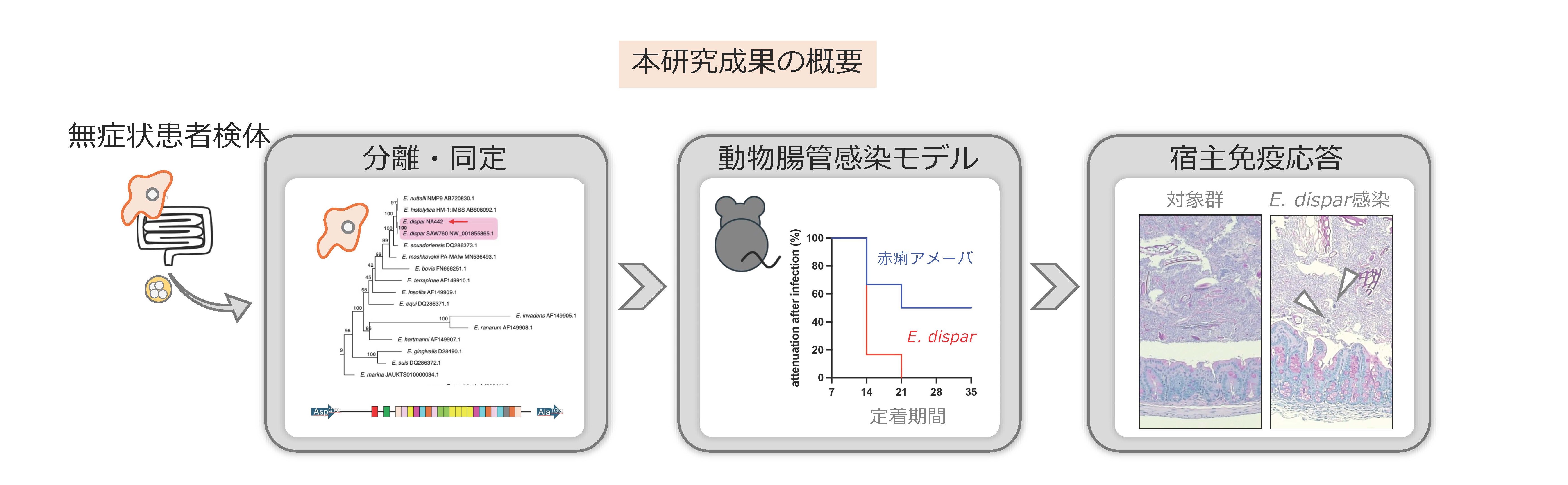
We report the first domestically acquired and culture-established E. dispar infection in Japan. A clinical strain, NA442, was isolated from fecal cysts of an HIV-positive patient without gastrointestinal symptoms and was maintained in stable monoxenic culture with Pseudomonas putida. Phylogenetic and tRNA-linked STR analyses confirmed the species identity and revealed genetic similarity to a Thailand-derived genotype.
Using NA442, we established a murine cecal infection model to characterize host immune responses. Infection induced detectable secretion of lipocalin-2 in stool, indicating epithelial stress; however, CXCL-1 and myeloperoxidase levels in cecal tissue remained at baseline, and no neutrophil infiltration or tissue destruction was observed. NA442 colonized the murine cecum for up to three weeks but elicited only mild epithelial thickening without the hallmark inflammatory signatures associated with E. histolytica.
Conclusions/Significance
This study provides the first in vivo evidence that E. dispar colonization triggers limited mucosal inflammation despite successful short-term persistence in the intestine. The identification of NA442 as the first domestic E. dispar case in Japan suggests the parasite may circulate unnoticed within the population. The NA442 strain establishes a valuable experimental tool for comparative studies of pathogenic versus non-pathogenic Entamoeba species and contributes to understanding the determinants of intestinal virulence and host immune modulation.