

2026-08-13 ペンシルベニア州立大学(Penn State)
<関連情報>
- https://www.psu.edu/news/research/story/childhood-abuse-and-neglect-linked-later-life-inflammation-premature-birth
- https://onlinelibrary.wiley.com/doi/10.1002/dev.70178
- https://www.sciencedirect.com/science/article/abs/pii/S0306453013002680
- https://www.frontiersin.org/journals/psychiatry/articles/10.3389/fpsyt.2020.00504/full
妊娠中の炎症性ストレス反応は、世代間リスク連鎖における連結要素となる Inflammatory Stress Response During Pregnancy as a Connecting Link in Intergenerational Risk Cascades
Heidemarie K. Laurent, Sherryl H. Goodman, Karen D. Rudolph, Kento Suzuki, Penina Backer, Aastha Dhimal, Sarah Pikhit, Douglas A. Granger
Developmental Psychobiology published: 30 June 2026
DOI:https://doi.org/10.1002/dev.70178
ABSTRACT
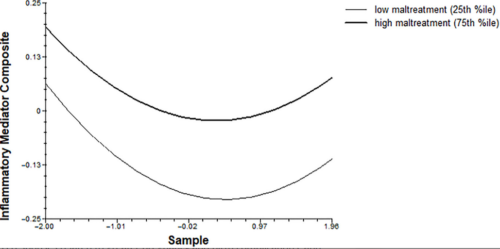
Pregnancy represents a critical juncture for intergenerational transmission of stress-related health vulnerabilities when child-bearers’ history of maltreatment may precipitate stress responses that adversely impact maternal and fetal outcomes. We aimed to shed light on this path by testing hypotheses that (1) childhood maltreatment would predict oral inflammatory responses to acute stress in late pregnancy, and (2) these inflammatory responses would relate to subsequent obstetric complications. Hypotheses were tested in a community sample of women (n = 158) from a larger longitudinal study. Participants reported a history of maltreatment and completed the Trier Social Stress Test during the third trimester of pregnancy. Five saliva samples collected before and after the task were assayed for pro-inflammatory cytokines (IL1β, IL6, TNFα) and C-reactive protein (CRP) to index oral inflammation. At 3 months postnatal, women reported pregnancy and birth complications, and birth outcomes. Multilevel models of inflammatory response trajectories supported hypothesized paths: Greater childhood maltreatment—especially physical neglect and sexual abuse—predicted higher and/or extended inflammatory stress responses. In turn, higher inflammatory stress responses related to greater pregnancy and birth complications, and extended inflammatory responses related to a greater likelihood of preterm birth. Findings support oral inflammatory response to stress as a potential link to target in intergenerational health risk transmission.
マインドフルネスが恋愛関係にあるパートナーの葛藤に対するコルチゾール反応と心理的適応との関係に及ぼす性別特有の影響 Sex-specific effects of mindfulness on romantic partners’ cortisol responses to conflict and relations with psychological adjustment
Heidemarie Laurent, Sean Laurent, Robin Hertz, Dorianne Egan-Wright, Douglas A. Granger
Psychoneuroendocrinology Available online: 6 August 2013
DOI:https://doi.org/10.1016/j.psyneuen.2013.07.018
Abstract
Mindfulness is known to improve individuals’ and couples’ subjective stress regulation, but little is known about how it impacts hypothalamic–pituitary–adrenal (HPA) axis responses to acute psychosocial stress. The current study tested effects of dispositional mindfulness facets on young adult couples’ cortisol responses to a conflict discussion stressor, as well as associations with psychological adjustment. One hundred heterosexual couples completed the five facet mindfulness questionnaire one week before engaging in a conflict discussion task. Each partner provided five saliva samples from pre- to post-conflict, which were assayed for cortisol. Measures of adjustment – depression and anxiety symptoms and global well-being – were also completed at this session. Hierarchical linear modeling of cortisol trajectories revealed sex-specific effects; whereas women’s mindfulness (nonreactivity facet) predicted higher conflict stress cortisol levels, men’s mindfulness (describing facet) predicted less pronounced cortisol reactivity/recovery curves. These patterns were related to better adjustment—lower depression symptoms for women and greater well-being for men. Implications for sex differences in mindfulness benefits are discussed.
幼少期の身体的ネグレクトは、成人期における繰り返される心理社会的ストレスに対する全身性および細胞内炎症反応の亢進と関連している Childhood Physical Neglect Is Associated With Exaggerated Systemic and Intracellular Inflammatory Responses to Repeated Psychosocial Stress in Adulthood
Hannah M. C. Schreier,Yuliya I. Kuras,Christine M. McInnis,Myriam V. Thoma,Danielle G. St Pierre,Luke Hanlin,Xuejie Chen ,Diana Wang ,Dena Goldblatt,Nicolas Rohleder
Frontiers in Psychiatry Published:05 June 2020
DOI:https://doi.org/10.3389/fpsyt.2020.00504
Abstract
Experiences of child maltreatment are associated with a host of adverse mental and physical health outcomes in adulthood. Altered reactivity to psychosocial stress exposure may partially explain known associations between early experiences of maltreatment and later life health. The present study focuses on examining whether experiences of child maltreatment are associated with physiological reactions to initial and repeated psychosocial stress in adulthood. To this end, 44 healthy adults (52% male, aged 18–65) completed the Childhood Trauma Questionnaire to provide information about exposure to child maltreatment and completed the Trier Social Stress Test (TSST) on 2 consecutive days. Peripheral blood was collected prior to as well as 30 and 120 min following the TSST on each day. Plasma Interleukin-6 (IL-6) and gene expression of IL-6, IL-1β, nuclear factor-kB (NF-kB), and inhibitor of kB (IkB) were measured from each blood sample. Total CTQ scores were unrelated to plasma IL-6 and gene expression (ps > .10) but a history of childhood physical neglect was associated with increased interleukin-1β (β =.35; p =.02; R2 =.19) and nuclear factor-kB (β =.30; p =.046; R2 =.13) expression following initial stress. Following repeated exposure to the TSST, childhood physical neglect was associated with increased plasma IL-6 reactivity (β =.34; p =.02; R2 =.16) and increased expression of nuclear factor-kB (β =.31; p =.04; R2 =.08). Finally, childhood physical neglect was associated with decreased habituation following repeated exposure to the TSST. Other CTQ subscales were not related to plasma IL-6 and gene expression when considered individually. Results from this study are suggestive of a unique effect of childhood physical neglect on the physiological stress response following initial and repeated exposure to a common psychosocial stressor. This provides important directions for future research because the effect of childhood physical neglect on long-term neglect are not well understood and in need of further investigation.

