2026-08-17 国立がん研究センター
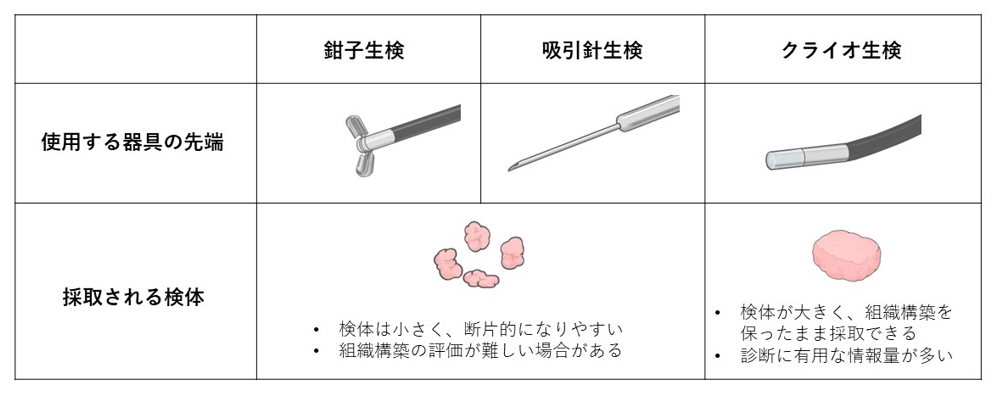
図1 従来の生検法(鉗子生検や吸引針生検)とクライオ生検の違い
<関連情報>
- https://www.ncc.go.jp/jp/information/pr_release/2026/0817/index.html
- https://www.thelancet.com/journals/lanres/article/PIIS2213-2600(26)00191-8/abstract
末梢肺病変に対する凍結生検と従来の気管支鏡検査による生検の比較(Cryo-RCT):非盲検、並行群間、ランダム化比較試験 Cryobiopsy versus conventional bronchoscopic sampling for peripheral pulmonary lesions (Cryo-RCT): an open-label, parallel-group, randomised trial
∙ Toshiyuki Nakai, MD ∙ Dongil Park, MD ∙ Ching-Kai Lin, MD ∙ Hideaki Furuse, MD ∙ Takuya Kawahara, PhD ∙ et al.
The Lancet Respiratory Medicine Published: July 29, 2026
DOI:https://doi.org/10.1016/S2213-2600(26)00191-8
Summary
Background
Diagnostic yield for peripheral pulmonary lesions using conventional bronchoscopic sampling remains suboptimal. We evaluated whether stand-alone cryobiopsy using single-use cryoprobes improves diagnostic yield during bronchoscopy guided by radial endobronchial ultrasound.
Methods
This international, open-label, randomised trial was done across six centres in Japan, Malaysia, South Korea, and Taiwan. Patients aged 18 years or older with peripheral pulmonary lesions up to and including 30 mm visualised using radial endobronchial ultrasound were included. Patients with within (ie, concentric) findings or adjacent-to or eccentric findings were randomly assigned (1:1) to stand-alone cryobiopsy or conventional sampling. In the cryobiopsy group, bronchoscopists used a single-use cryoprobe and aimed to obtain 1–3 specimens, with en bloc removal of the bronchoscope and cryoprobe for each biopsy. In the conventional sampling group, bronchoscopists aimed to obtain five or more specimens when feasible using standard bronchoscopic sampling instruments, including forceps, aspiration needles, or both. The primary endpoint was histology-based diagnostic yield (definitive histological diagnosis consistent with the final diagnosis), which was assessed in all randomly assigned patients with confirmed lesion visualisation who were evaluable for the primary endpoint and tested hierarchically in the prespecified adjacent-to or eccentric cohort, followed by the overall cohort. Safety was assessed in all eligible randomly assigned patients. This trial is registered with the University Hospital Medical Information Network Clinical Trials Registry, UMIN000049329, and is completed.
Findings
Between Nov 1, 2022, and March 25, 2025, 660 patients were enrolled; 627 were randomly assigned (314 [50%] to cryobiopsy and 313 [50%] to conventional sampling). Two patients in the conventional sampling group were excluded from the primary analysis after randomisation. Median age was 70 years (IQR 61–76), 287 (46%) of 625 patients were female and 338 (54%) were male. In the adjacent-to or eccentric cohort, histology-based diagnostic yield was 77% (128 of 167 patients) with cryobiopsy and 65% (108 of 167) with conventional sampling (estimated difference 12·4% [95% CI 2·8–22·0]; p=0·0060). In the overall cohort, diagnostic yield was 83% (262 of 314) and 75% (233 of 311; estimated difference 8·9% [95% CI 2·8–15·0]; p=0·0023). Moderate bleeding occurred in 120 (38%) of 314 patients in the cryobiopsy group and 60 (19%) of 312 patients in the conventional sampling group; severe bleeding was uncommon (two [1%] vs three [1%]). Pneumothorax occurred in six (2%) patients in the cryobiopsy group and one (<1%) patient in the conventional sampling group (chest-tube drainage was required in five [2%] patients vs none). Serious adverse events were infrequent (seven [2%] in the cryobiopsy group vs five [2%] in the conventional sampling group).
Interpretation
In patients with peripheral pulmonary lesions undergoing radial endobronchial ultrasound-guided bronchoscopy, cryobiopsy achieved a higher histology-based diagnostic yield than conventional sampling, although moderate bleeding and pneumothorax were more frequent. These findings support cryobiopsy as a valuable tissue-acquisition strategy for peripheral pulmonary lesions, particularly when the probe–lesion relationship is adjacent to or eccentric.
Funding
JSPS KAKENHI.