2026-08-19 合肥物質科学研究院(HFIPS)
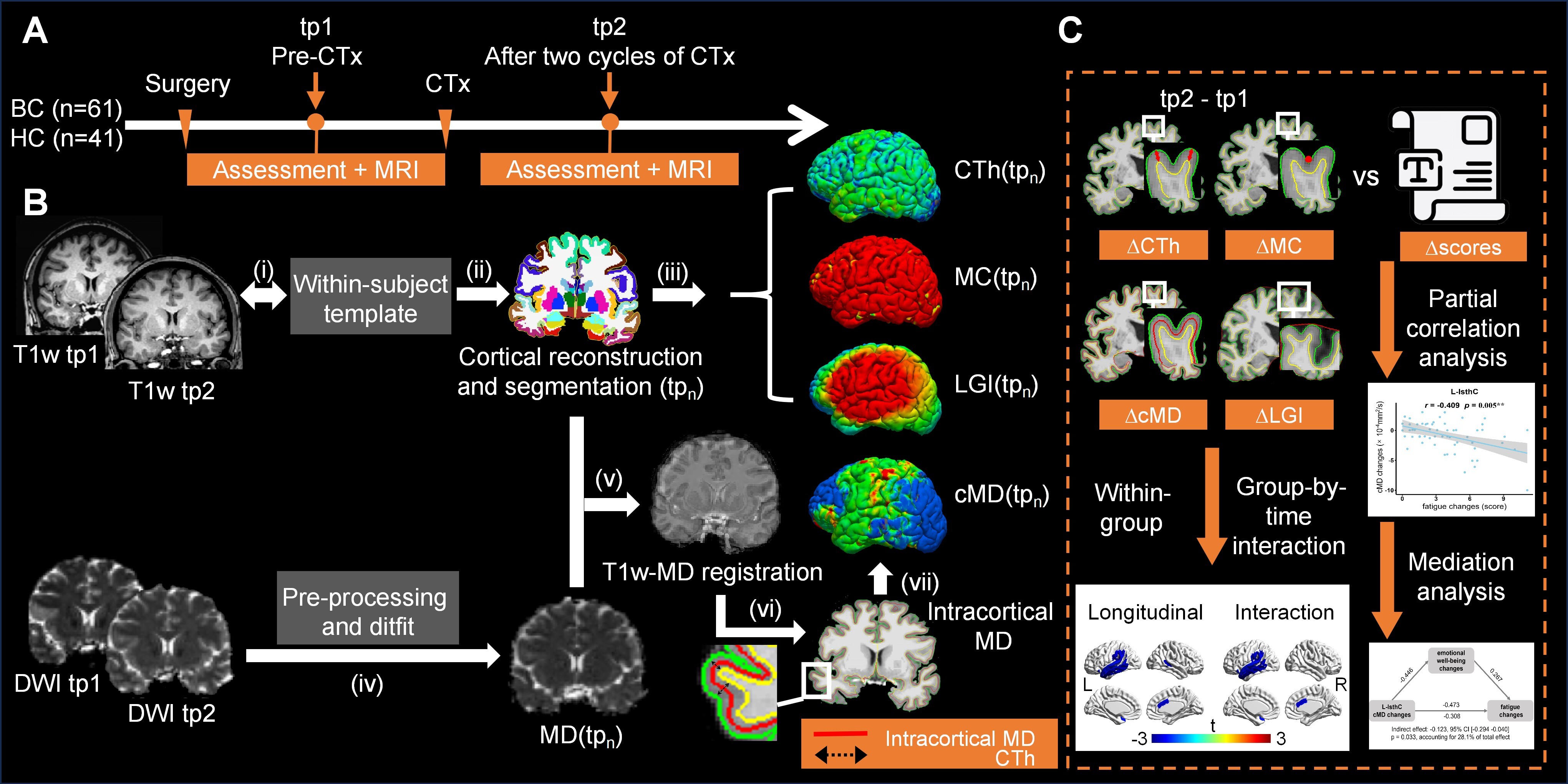
Study design, imaging processing, and statistical workflow. (Image by ZHOU Yanfei)
<関連情報>
- https://english.hf.cas.cn/nr/rn/202608/t20260819_1188075.html
- https://acsjournals.onlinelibrary.wiley.com/doi/10.1002/cncr.70558
がん関連疲労の初期神経学的特徴:乳がん化学療法中の皮質微細構造および巨視的構造変化に関する縦断的磁気共鳴画像研究 Early neural signatures of cancer-related fatigue: A longitudinal magnetic resonance imaging study of cortical micro- and macrostructural changes during breast cancer chemotherapy
Yanfei Zhou MS, Jin Liu PhD, Xiao Fu MS, Jian Fan MS, Zong Cao MS, Jing Li MS, Ruiping Ye PhD, Hongzhi Wang MS, Lizhuang Yang PhD, Hai Li PhD
Cancer Published: 28 July 2026
DOI:https://doi.org/10.1002/cncr.70558
Abstract
Background
Cancer-related fatigue is a prevalent and debilitating symptom in patients with breast cancer (BC) undergoing chemotherapy (CTx), yet its early neural correlates remain incompletely understood.
Methods
This longitudinal study included 61 female patients with BC and 41 healthy female controls assessed before CTx and after two cycles of CTx, or at matched intervals. Assessments included 3T brain magnetic resonance imaging, patient-reported fatigue and quality-of-life measures, clinician-rated affective symptom scales, and an objective cognitive screening measure. Surface-based analyses were used to extract cortical microstructural measures, including cortical mean diffusivity (cMD), and macrostructural measures. Linear mixed-effects models were used to examine longitudinal changes and group-by-time interaction effects in clinical, patient-reported, cognitive, and cortical structural outcomes, as well as their associations during early CTx.
Results
During early CTx, patients with BC showed worsening fatigue and worsened emotional well-being, and changes in these outcomes were positively associated. cMD decreased over time in the left isthmus cingulate cortex, and the magnitude of this decrease was associated with worsening fatigue and worsened emotional well-being. Mediation analysis suggested an indirect association between cMD changes in this region and fatigue through worsened emotional well-being.
Conclusion
These findings suggest that early increases in fatigue during CTx are linked to worsening emotional well-being and region-specific cortical microstructural changes. The results highlight a potentially informative neural-affective pathway in the early emergence of fatigue, while requiring replication and further validation before clinical translation.