
2026-08-17 中国科学院(CAS)
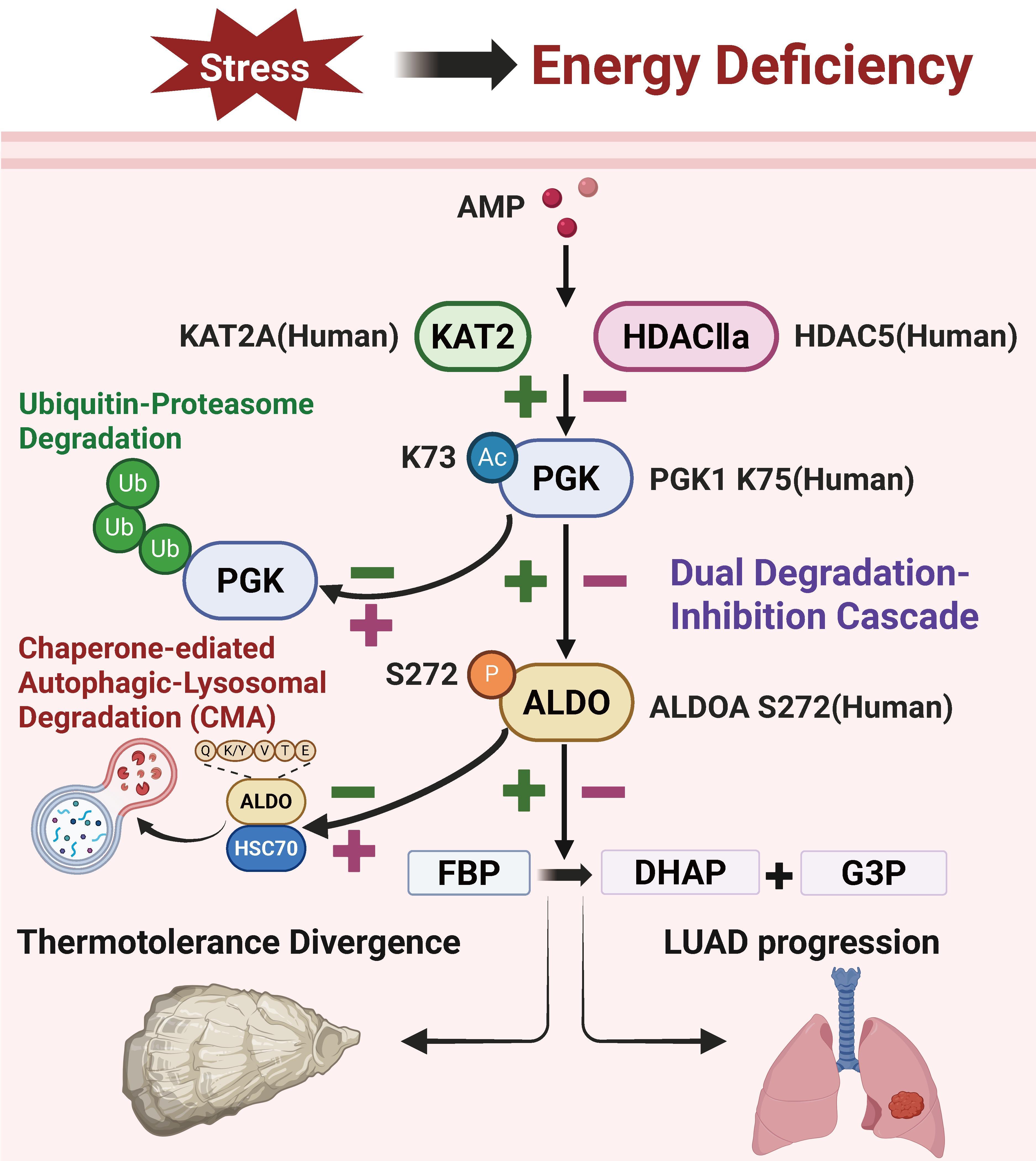
The metazoan-conserved KAT2/HDACIIa–PGK–ALDO axis inhibits dual protein degradation systems to enhance glycolysis, linking oyster thermal tolerance to cancer progression. (Image by IOCAS)
<関連情報>
- https://english.cas.cn/newsroom/research-news/202608/t20260818_1187972.shtml
- https://www.pnas.org/doi/10.1073/pnas.2533429123
KAT2/HDACⅡa–PGK–ALDO軸は、エネルギーストレスと解糖増幅を結びつける二重分解阻害カスケードを構成する The KAT2/HDACⅡa–PGK–ALDO axis constitutes a dual degradation inhibition cascade links energy stress to glycolytic amplification
Chaogang Wang, Mingyang Du, Yutong Liu, +6 , and Li Li
Proceedings of the National Academy of Sciences Published:August 18, 2026
DOI:https://doi.org/10.1073/pnas.2533429123
Abstract
Cells reprogram glycolysis pathway to cope with energy deficiency, in which the catalytic activity, stability, and noncanonical functions of glycolytic enzymes are finely regulated by posttranslational modifications (PTMs). Here, we report a metazoan-conserved dual degradation inhibition cascade whereby energy stress coordinates acetylation-phosphorylation crosstalk that simultaneously enhances glycolytic output and suppresses two protein degradation systems. Specifically, KAT2 (KAT2A)/HDACIIa (HDAC5)-mediated acetylation of PGK at K73 (PGK1; K75) antagonizes its ubiquitin–proteasomal degradation while strengthening its interaction with ALDO (ALDOA). Then, PGK exerts noncanonical kinase activity to phosphorylate ALDO at S272, thereby enhancing ALDO’s substrate affinity and suppressing its chaperone-mediated autophagic–lysosomal degradation by inhibiting the interaction with HSC70 to simultaneously stabilize and activate ALDO to amplify glycolytic flux. This ancient survival axis underlies thermotolerance divergence in oysters and is hijacked in human lung adenocarcinoma to drive malignant proliferation. Our study integrates environmental adaptation and tumorigenesis through a unified metabolic signaling axis, broadening our understanding of PTM crosstalk in evolution and disease.
00163-5/asset/d26dbf50-c14a-4fcd-bc70-9c159554fc3e/main.assets/gr1_lrg.jpg "ロンドン超低排出ゾーン導入が子どもの肺成長改善と関連(Introduction of London’s ULEZ linked to improved lung growth in children)")