2026-08-19 国立精神・神経医療研究センター,浜松医科大学,大阪大学
<関連情報>
- https://www.ncnp.go.jp/topics/detail.php?@uid=L398u75RvZvYDtiA
- https://link.springer.com/article/10.1007/s00787-026-03114-3
注意欠陥多動性障害の生物学におけるアディポネクチンの関与 Involvement of adiponectin in the biology of attention deficit hyperactivity disorder
Nagahide Takahashi,Toshiki Iwabuchi,Tomoko Nishimura,Akemi Okumura,Taeko Harada,Md Shafiur Rahman & Kenji J. Tsuchiya
European Child & Adolescent Psychiatry Published:14 July 2026
DOI:https://doi.org/10.1007/s00787-026-03114-3
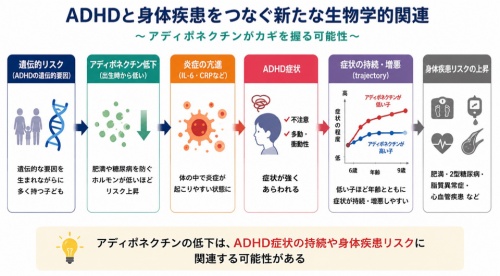
Abstract
We investigated the involvement of adiponectin in the development of attention-deficit/hyperactivity disorder (ADHD), using a multi-pronged approach integrating cord blood adiponectin concentrations, polygenic risk scores derived from publicly available GWAS summary statistics, and Mendelian randomization. This study aimed to evaluate both upstream genetic influences and downstream adiponectin-level associations. Using a combination of longitudinal cord blood data (N = 531) and genome-wide association studies of ADHD (N = 55,374) and adiponectin (N = 46,434), we examined observational, genetic, and associations linking adiponectin with ADHD. Lower cord blood adiponectin levels were associated with higher ADHD symptoms at ages 5–6 and 8–9, and predicted membership in the increasing-symptom trajectory group. Gene-set analysis demonstrated pathway-level overlap between ADHD and adiponectin regulation. Genetic correlation analysis showed a significant negative correlation between ADHD and adiponectin levels. Mendelian randomization provided stronger evidence for an association of ADHD on adiponectin levels. Polygenic risk score analysis also demonstrated a negative association between genetic liability for ADHD and cord blood adiponectin levels. Additionally, lower adiponectin levels were found to be associated with elevated inflammatory markers in the cord blood samples obtained from the cohort study, which may provide a potential explanation for the higher prevalence of metabolic comorbidities observed in individuals with ADHD. These findings suggest that adiponectin may be associated with the biologyof ADHD and targeting adiponectin regulation may offer a novel approach for managing ADHD and its related health risks.