2026-08-20 長崎大学
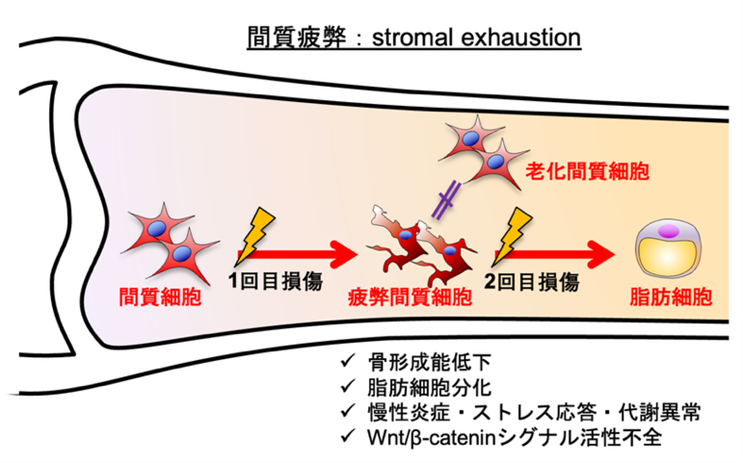
図1 間質疲弊:stromal exhaustionの全貌。
骨髄間質細胞は損傷を受けると疲弊状態に陥り、再損傷時には骨形成能を失い脂肪細胞になってしまう。
<関連情報>
- https://www.nagasaki-u.ac.jp/ja/science/science473.html
- https://www.nature.com/articles/s41467-026-76108-z
損傷による間質細胞の疲弊は、本来備わっている再生能力を阻害する Injury-driven stromal exhaustion disrupts intrinsic regenerative capability
Sixun Wu,Hirotaka Matsumoto,Keita Kondo,Aiko Kuroda,Jumpei Morita,Takeshi Moriishi,Shawn A. Hallett,Yuki Matsuo,Azumi Noguchi,Mitsuaki Ono,Makoto Abe,Kosei Ito,Shinsuke Ohba,Noriaki Ono & Yuki Matsushita
Nature Communications Published:19 August 2026
DOI:https://doi.org/10.1038/s41467-026-76108-z
Abstract
Bone marrow stromal cells, marked by leptin receptor (Lepr) and C-X-C motif chemokine ligand 12 (Cxcl12), orchestrate osteogenesis and maintain bone homeostasis. Following injury, these stromal cells directly generate reparative bone and subsequently restore the marrow microenvironment, a process widely regarded as a reliable regenerative response. However, it remains unclear whether stromal cells retain full regenerative capacity after prior injury. Here, we show that Lepr+Cxcl12+ stromal cells have limited regenerative capacity and become dysfunctional upon repeated activation, defining a state of stromal exhaustion. Lepr-Cre-labeled stromal cells progressively lose osteogenic potential after repeated injury and instead differentiate into bone marrow adipocytes. Exhausted stromal cells are distinct from aging stromal cells, exhibiting metabolic abnormalities, chronic inflammation associated with stress responses, and impaired regenerative plasticity. Furthermore, β-catenin deletion during injury repair induces adipogenesis through stromal lineage switching, whereas pharmacological and genetic activation of Wnt/β-catenin signaling partially rescues osteogenesis, indicating that dysregulated Wnt/β-catenin signaling drives stromal exhaustion and impaired regeneration. As repeated regenerative activation may occur in recurrent fractures, orthopedic surgeries, osteoporosis, and osteogenesis imperfecta, stromal exhaustion represents a critical barrier to bone regeneration and a potential therapeutic target for restoring stromal plasticity.