
2026-08-20 東京科学大学
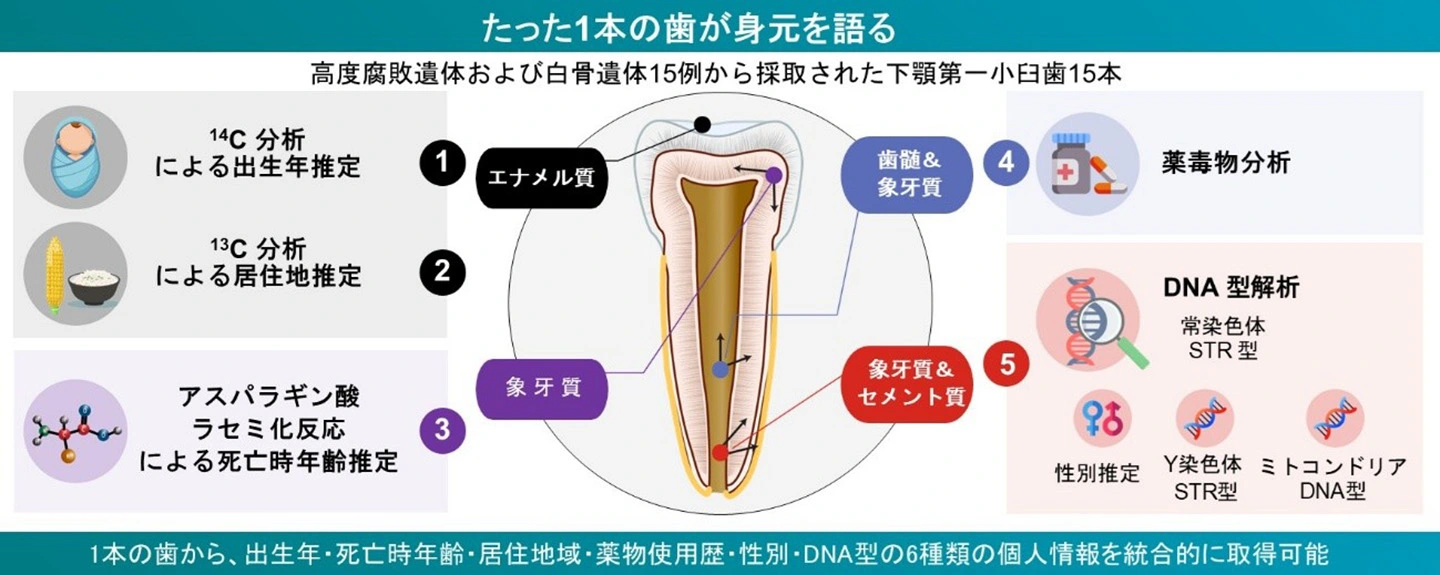
図1. たった1本の歯から、出生年・死亡時年齢・居住地域・薬物使用歴・性別・DNA型の6種類の個人情報を統合的に取得可能
<関連情報>
単一の歯を用いたヒト識別のための複数の法医学的知見と、死後経過が進んだ遺体への適用可能性 Multiple forensic insights for human identification using single teeth with applicability to advanced postmortem remains
Sayaka Yamada,Hisako Saitoh,Kanju Saka,Saki Minegishi,Toru Moriya,Mirei Takeyama,Hajime Utsuno,Shuuji Namiki,Muhammad Garry Syahrizal Hanafi,Nanami Aoki,Yohsuke Makino,Hirotaro Iwase,Fuyuki Tokanai & Koichi Sakurada
Scientific Reports Published:19 August 2026
DOI:https://doi.org/10.1038/s41598-026-62088-z
Abstract
Prolonged postmortem intervals cause soft tissue loss, complicating identification in disasters and criminal investigations. We used a single mandibular first premolar from bodies (n = 15) with a long postmortem interval for simultaneous 14C and δ13C isotope analysis, amino acid racemization analysis, DNA profiling, and toxicological analysis. 14C analysis gave multiple estimated birth years, including actual birth year, in 14 of 15 cases, and amino acid racemization analysis estimated ages at death within a margin of mean error of − 5.82 ± 6.87 years (mean absolute error (MAE) = 7.93, r = 0.86). Integrating both results increased the year of birth estimation accuracy (0.57 ± 6.36 years, MAE = 5.01, r = 0.95). Estimated region based on δ13C analysis did not contradict known individual information. DNA analysis estimated sex in all cases, and a sufficient number of autosomal short tandem repeat (STR) loci for individual identification was detected in 12 cases. Mitochondrial DNA typing and Y-STR analysis were also successful. Toxicological analysis of dental pulp detected drugs consistent with autopsy screening results and drug use information. The findings suggest that various identifying information can be obtained from a single tooth, representing a novel, useful strategy for rapidly narrowing potential individuals.

