2026-08-21 東北大学
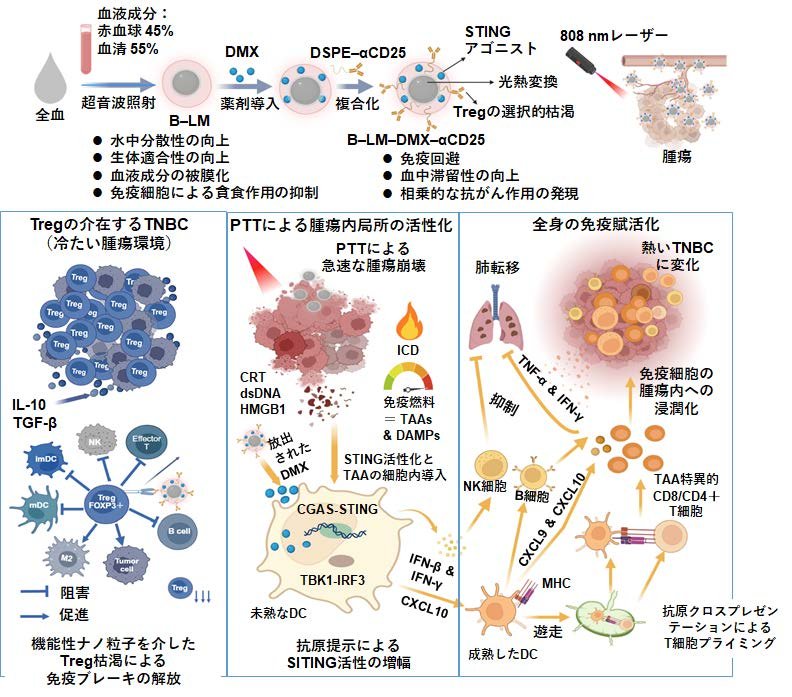
図1. 本研究の概念(B-LM-DMX-αCD25の設計と三位一体の治療メカニズム)
<関連情報>
- https://www.tohoku.ac.jp/japanese/2026/08/press20260821-03-Blood.html
- https://advanced.onlinelibrary.wiley.com/doi/10.1002/advs.77069
血液細胞に偽装された液体金属ナノ複合体がTreg細胞の枯渇とSTING増幅型光熱免疫を誘導し、転移性トリプルネガティブ乳がんの治療に有効である Blood Cell-Camouflaged Liquid Metal Nanoconjugates Orchestrate Treg Depletion and STING-Amplified Photothermal Immunity for Metastatic Triple-Negative Breast Cancer Therapy
Nina Sang, Eijiro Miyako
Advanced Science Published:11 August 2026
DOI:https://doi.org/10.1002/advs.77069
ABSTRACT
Triple-negative breast cancer (TNBC) remains highly lethal due to aggressive metastasis and profound immunosuppression by regulatory T cells (Tregs). Here, we present a biomimetic liquid metal (LM)-based photothermal immunotherapeutic nanoplatform exploiting gallium-based LMs to orchestrate cascade amplification of antitumor immunity. The engineered nanoplatform (B–LM–DMX–αCD25) integrates an LM photothermal core with dual immunomodulatory components—anti-CD25 antibody for Treg depletion and stimulator of interferon genes (STING) agonist 5,6-dimethylxanthenone-4-acetic acid (DMX) for innate immune activation—while blood-derived camouflaging enhances immune evasion and tumor accumulation. Quantitative RT-PCR of 13 immune-related genes confirmed STING engagement, robust CD8+ cytotoxic T-cell infiltration, and Treg depletion in treated tumors. This platform operates through three synchronized mechanisms: (1) selective intratumoral Treg depletion dismantling immunosuppression; (2) near-infrared-triggered LM-mediated photothermal therapy (58°C within 5 min) inducing immunogenic cell death and releasing tumor-associated antigens; and (3) STING pathway activation promoting dendritic cell maturation and tumor-specific cytotoxic T-cell responses, collectively transforming immunologically “cold” TNBC into immune-responsive tumors. In orthotopic 4T1 models, the nanoplatform achieves significant tumor regression with enhanced survival, while in metastatic models, it reduces pulmonary metastatic nodules and extends median survival beyond 70 days. This work establishes a paradigm-shifting biomimetic LM-based nanodelivery strategy addressing fundamental immunological barriers in TNBC through coordinated photothermal–immunotherapy, offering a clinically translatable approach for TNBC.