2026-08-21 コロンビア大学
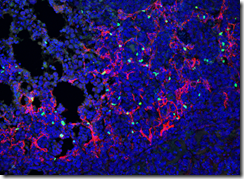
Uncovering how the newly identified fibroblast cells in the lung protect cancer was a tough task. The breakthrough came after graduate student Olivia Ringham spent hours examining images of the cells around lung tumors. “I remember being in the microscope room with my slides of all my different cancer models, looking around, and then I just saw this striking pattern of regulatory T cells sitting amidst the fibroblasts, and I was like, ‘that’s interesting,'” Ringham recalls. Image courtesy of Olivia Ringham / Columbia University Vagelos College of Physicians and Surgeons.
<関連情報>
- https://www.cuimc.columbia.edu/news/scientists-uncover-hidden-cell-type-shields-lung-cancer
- https://www.nature.com/articles/s41590-026-02607-2
新規CAF集団が肺癌における過剰抑制性制御性T細胞の動員と局在を調整する A novel CAF population coordinates hyper-suppressive regulatory T cell recruitment and localization in lung cancer
Olivia R. Ringham,Monica Rivera,Lucas F. Loffredo,Melih Arda Ozsoy,Christina M. Healy,Maye F. Cheng,Yinuo Jin,Noah Chen,Kenia de los Santos-Alexis,Elham Azizi,Anjali Saqi,Matthew B. Buechler,Carla P. Concepcion-Crisol & Nicholas Arpaia
Nature Immunology Published:11 August 2026
DOI:https://doi.org/10.1038/s41590-026-02607-2
Abstract
Across many solid tumor types, cancer-associated fibroblasts (CAFs) are abundant and heterogeneous, with distinct subpopulations exerting immunomodulatory functions. Here we identify a novel population of immunomodulatory CAFs (imCAFs) in primary lung adenocarcinoma and pulmonary metastases, characterized by cell adhesion molecule L1-like (CHL1) expression and enriched in immune regulation and chemokine signaling programs. Through single-cell and spatial transcriptomics, we demonstrate that imCAFs are spatially colocalized with CXCR3+ regulatory T (Treg) cells, a hyper-suppressive subset accumulating at the tumor border. imCAFs produce CXCL9, driving CXCR3+ Treg cell recruitment and promoting an immunosuppressive microenvironment. CXCR3+ Treg cells display enhanced proliferative and suppressive capacity and are transcriptionally distinct from CXCR3− counterparts. Genetic ablation of Cxcr3 in Treg cells or Cxcl9 in stromal cells reduces Treg cell accumulation, enhances CD8+ T cell activation and decreases tumor burden. Analogous CHL1+ imCAF-like fibroblasts in human non-small cell lung cancer colocalize with Treg cells, and elevated CHL1 expression is associated with reduced cytotoxicity and decreased progression-free survival, highlighting the imCAF–CXCL9–CXCR3+ Treg axis as a promising therapeutic target.