2026-08-28 東京科学大学
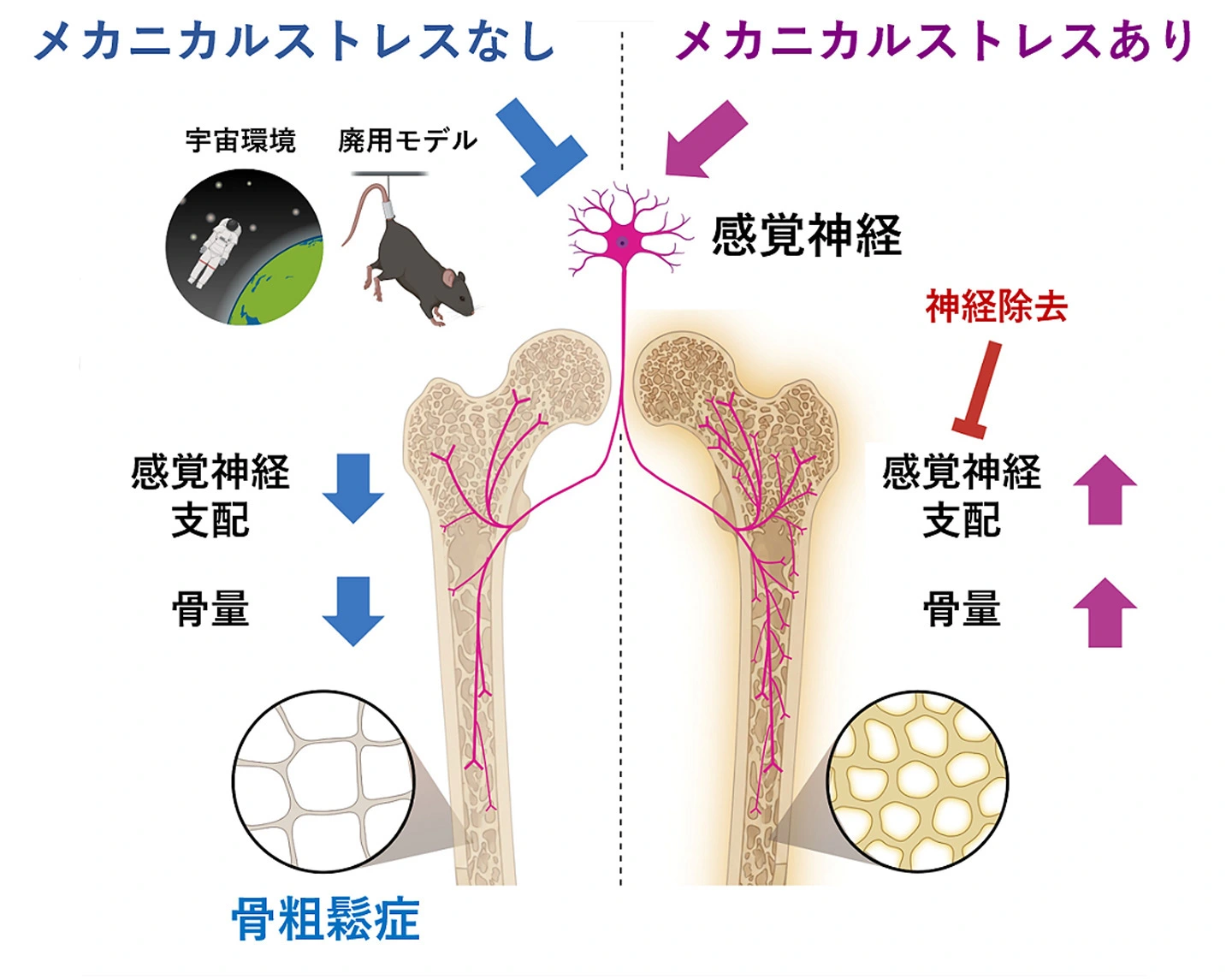
研究概略図. 宇宙環境や尾部懸垂などによって骨へのメカニカルストレスが減少すると、骨内に投射する感覚神経が減少し、骨は骨粗鬆症に近い状態となる(左)。一方、メカニカルストレスを加えると、骨内に投射する感覚神経が回復し、骨量も回復する(右)。しかし、神経除去などによって感覚神経の骨への投射が障害されると、メカニカルストレスを加えても骨量の回復は認められない。
<関連情報>
感覚神経は機械的負荷の軽減または再負荷に応じて骨恒常性を調節する:宇宙飛行実験および地上での機械的負荷軽減モデルからの証拠 Sensory nerves regulate bone homeostasis in response to mechanical unloading or reloading: evidence from a spaceflight experiment and ground-based mechanical unloading models
Shohei Tsujino,Hiroki Ochi,Risa Okada,Daisuke Kamimura,Kurando Utagawa,Takaei Shin,Hironori Yamada,Aiko Unno,Satoko Sunamura,Chihiro Akazawa,Masafumi Muratani,Dai Shiba,Toshitaka Yoshii & Shingo Sato
Bone Research Published:28 August 2026
DOI:https://doi.org/10.1038/s41413-026-00563-z
Abstract
Mechanical loading is crucial for maintaining bone mass, and understanding how bone remodels in response to mechanical loading is essential for treating musculoskeletal disorders. Recently, sensory nerves inside bone were identified as mechanical regulators of bone homeostasis. However, how the structure and networks of sensory nerves are altered in response to changes in mechanical loading remains unclear. To address this question, we performed a spaceflight experiment on the International Space Station (ISS) and used two ground-based mechanical unloading models, tail suspension (TS) and hindlimb immobilization. In a spaceflight experiment, Sox10-Venus mice, in which green fluorescent protein is expressed in nerve fibers, were housed at the ISS for 3 weeks, and we demonstrated that microgravity exposure significantly decreased bone mass and impaired nerve abundance inside the bone. These changes were reproduced in both ground-based models. Mechanical reloading after TS induced the recovery of bone mass and nerve abundance. Retrograde tracing experiments revealed that mechanical changes specifically affected sensory innervation inside bone without altering the number of neurons in the dorsal root ganglia. Notably, continuous administration of calcitonin gene-related peptide (CGRP), a neuropeptide secreted from sensory nerves, prevented unloading-induced bone loss. Furthermore, both surgical and genetic ablation of sensory nerves inhibited loading-induced trabecular bone recovery. These findings demonstrate that sensory nerves inside bone play a critical role in regulating bone homeostasis in response to mechanical changes and may aid in the development of therapeutic strategies for bone loss induced by mechanical unloading, such as prolonged bed rest and long-term space travel.