2026-08-27 神戸大学
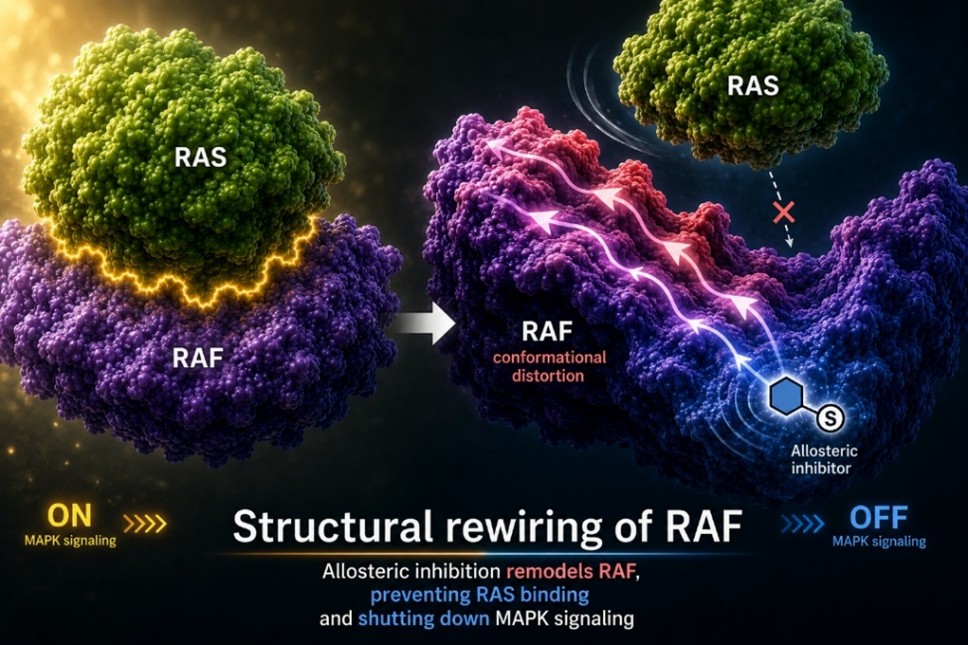
アロステリック阻害剤によるRAS–RAF相互作用阻害機構の模式図(研究グループ作成)
<関連情報>
- https://www.kobe-u.ac.jp/ja/news/article/20260827-68212/
- https://www.nature.com/articles/s41467-026-76337-2
低分子RAS/RAF阻害剤は、アロステリックRAF阻害を介してRAS駆動型癌を標的とする Small-molecule RAS/RAF inhibitors target RAS-driven cancers via allosteric RAF disruption
Yoko Yoshikawa,Hirokazu Kubota,Shigeyuki Matsumoto,Yoshiteru Makino,Takashi Kawamura,Hitomi Yuki,Naoki Sakai,Akira Shibaike,Megumi Okamura,Wakako Fujimoto-Sakisaka,Kou Honda,Taisuke Horikawa,Ichiro Mori,Morihito Okada,Manabu Horikawa,Kazumasa Horie,Michiyo Koyanagi-Aoi,Takashi Aoi,Tohru Kataoka,Tomoyo Okada,Atsuo Tamura,Teruki Honma,Takashi Kumasaka,Hiroo Koyama & Fumi Shima
Nature Communications Published:27 August 2026
DOI:https://doi.org/10.1038/s41467-026-76337-2
Abstract
RAS, a frequently mutated cancer-driver gene, has been the focus of intensive research, with numerous inhibitors developed to target RAS and its signalling molecules. With the advent of approved subtype-specific RAS inhibitors targeting KRASG12C mutation, the development of RAS inhibitors that are effective regardless of RAS mutation status is the next major challenge to address clinically prevalent RAS mutations and further overcome RAS-driven acquired resistance to currently available drugs. With the goal of obtaining broad-spectrum aberrant RAS-signalling inhibitors, we conduct multimodule drug screening for small-molecule compounds capable of RAS/RAF-binding inhibition. Structural studies of the hit compounds demonstrate that they covalently bind to a distinct site in the RAS-binding domain of RAF and allosterically disrupt RAF conformation, thereby preventing RAS/RAF interaction and downstream signalling. The compounds exhibit antitumour efficacy against multiple cancers with varying RAS mutations, including KRAS, NRAS and HRAS, and wild-type RAS-driven cancers in preclinical models. Furthermore, they effectively suppress tumour growth of BRAFV600E-melanoma with acquired BRAF inhibitor resistance by preventing RAS signal reactivation. These findings provide a possible approach for designing RAF-targeting compounds, and the resulting molecules may serve as the basis for developing RAS/RAF-signalling inhibitors with distinct mechanisms to overcome multiple RAS-driven cancers.