2026-08-27 岐阜大学
<関連情報>
- https://www.gifu-u.ac.jp/news/research/2026/08/entry27-15295.html
- https://www.nature.com/articles/s41467-026-76857-x
シス型グリカン-グリカン相互作用は、受容体シグナル伝達を調節する膜ナノドメインを組織化する Cis glycan–glycan interactions organize membrane nanodomains that tune receptor signaling
Kenichi G. N. Suzuki,Naoko Komura,Sachi Asano,Maina Takahashi,Eriko Yamaguchi,Ayano Yamazaki,Akihiro Imamura,Shusaku Shibutani,Rahul Chadda,Taka A. Tsunoyama,Takahiro K. Fujiwara,Koichiro M. Hirosawa,Kenichi Morigaki,Koichi Furukawa,Keiko Furukawa,Yoshio Yamauchi,Yukichi Kitamura,Masataka Nagaoka,Hiromune Ando & Akihiro Kusumi
Nature Communications Published:27 August 2026
DOI:https://doi.org/10.1038/s41467-026-76857-x
Abstract
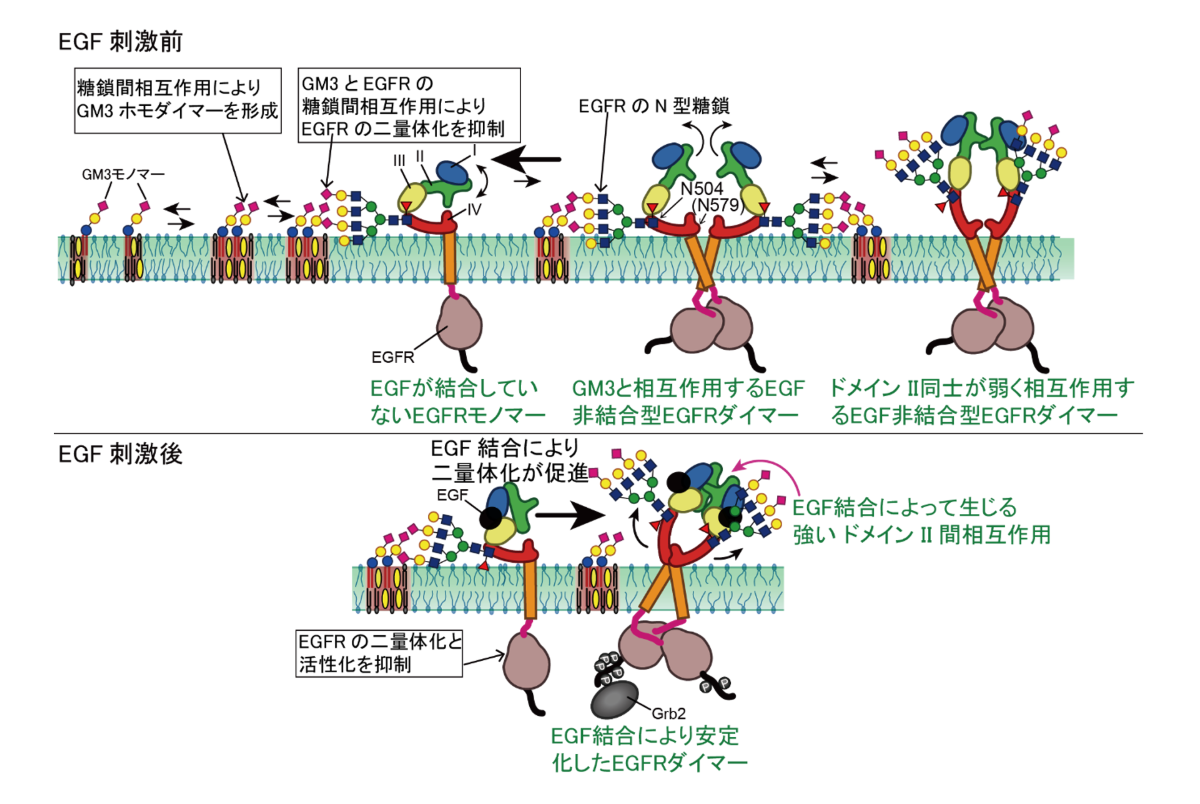
The plasma membrane (PM) is generally viewed as organized by coordinated interactions among proteins and lipids, largely overlooking the cell’s most extensive surface chemistry, the glycan layer. Here, we directly detect specific cis glycan–glycan interactions using single-molecule imaging of 39 chemically synthesized fluorescent ganglioside analogs in living cells and defined lipid bilayers. All gangliosides examined form transient, metastable homodimers via homophilic glycan interactions, which are stabilized by cholesterol to generate nanoscale ganglioside homodimer rafts. They represent fundamental organizing units underlying PM nano-heterogeneity. Using EGF receptor (EGFR) as a representative receptor, we show that the interactions of paired GM3 glycans in the GM3 homodimer raft with defined N-linked glycans on EGFR suppress ligand-independent EGFR dimerization by reducing the dimer formation rate and enhancing dissociation, and continue to slow dimerization after EGF stimulation. Our findings establish cis glycan–glycan interactions as an organizing principle of PM organization and receptor regulation.