2026-05-14 中国科学院(CAS)
◆脳卒中、脊髄損傷、膠芽腫、アルツハイマー病、パーキンソン病などの神経疾患は、血液脳関門(BBB)の存在や病変部位の複雑性により治療が困難である。本総説で紹介されたインテリジェント・ナノ医療システムは、従来の薬剤運搬体とは異なり、活性酸素種(ROS)、pH変化、酵素活性異常などの病変シグナルを感知して薬剤放出を制御できる。また、光、超音波、磁場、電気刺激などの外部刺激を利用して、神経活動調節やBBB透過性制御を高精度に行うことが可能である。特に集束超音波は臨床応用が期待される技術として注目された。さらにMRI、PET、光音響イメージング、NIR-IIイメージングなどを組み合わせた画像誘導型治療や、AIによるBBB透過予測・設計最適化も紹介された。
◆研究は、材料科学、神経科学、医療工学、AIを融合した次世代の個別化神経疾患治療の実現に向けた包括的な指針を提供している。
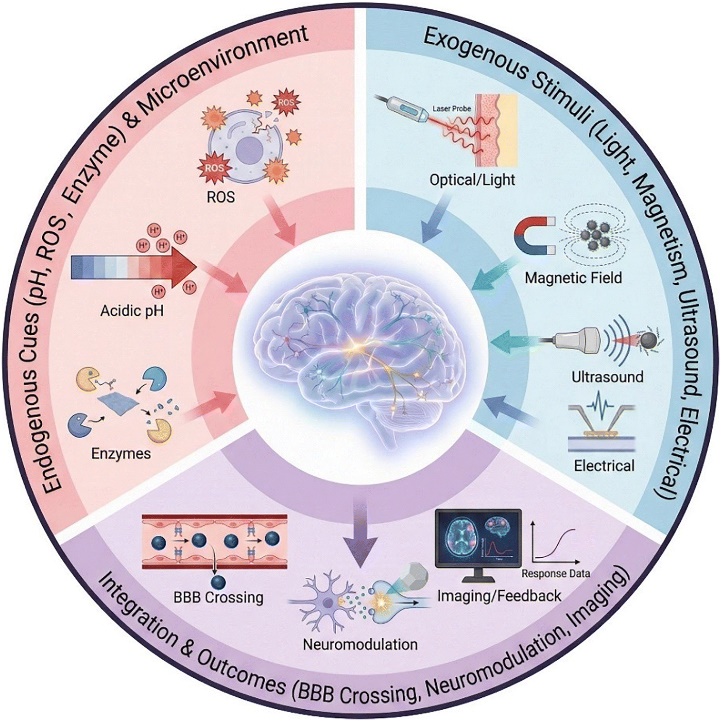
Schematic of stimuli-responsive nanoplatforms for brain-adaptive CNS therapy. (Image by SIC)
<関連情報>
- https://english.cas.cn/newsroom/research-news/202606/t20260604_1161123.shtml
- https://pubs.rsc.org/en/content/articlelanding/2026/cs/d5cs01323b
中枢神経系疾患に対する刺激応答性ナノプラットフォーム:送達、調節、およびイメージングの統合 Stimuli-responsive nanoplatforms for central nervous system disorders: integrating delivery, modulation, and imaging
Yihan Chen,Yuanqing Ding,Han Lin and Jianlin Shi
Chemical Society Review Published:05 May 2026
DOI:https://doi.org/10.1039/D5CS01323B
Abstract
Stimuli-responsive nanoplatforms have been reforming the landscape of central nervous system (CNS) therapeutics by successfully crossing the blood–brain barrier to allow spatiotemporal control over therapeutic activation, while simultaneously providing measurable imaging readouts for real-time monitoring. This review presents the rational design of nanoplatforms responsive to key endogenous cues, especially redox, pH and enzymatic signals, and discusses the therapeutic effects of exogenous physical stimuli, including light, ultrasound, magnetic and electrical fields, operated via real-time feedback. Beyond passive drug delivery, these integrated systems are endowed with the capacity to actively sense the localized microenvironment and utilize specific molecular signals for structural imaging, thereby enabling clinicians to personalize both drug dosimetry and stimulation timing for optimized outputs. Finally, we discuss the practical steps toward clinical translation by analyzing current trials and regulatory hurdles, and highlight how artificial intelligence can predict structure–function relationships and improve imaging clarity. When paired with scalable manufacturing, these tools are expected to promote the translation of brain-adaptive designs into viable clinical therapies.