2026-07-13 カリフォルニア大学リバーサイド校(UCR)
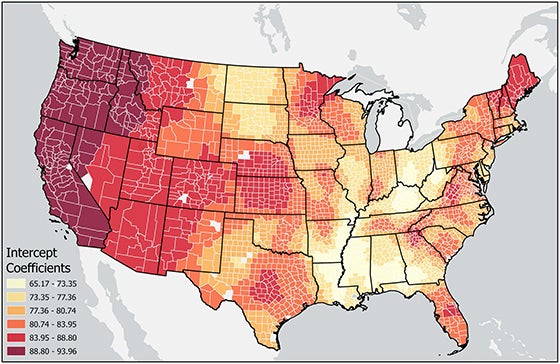
This map shows that differences in breastfeeding rates persist across the United States. Darker colors indicate counties where breastfeeding initiation rates are higher than expected, while lighter colors indicate counties where rates are lower than expected.
<関連情報>
- https://news.ucr.edu/articles/2026/07/13/study-maps-breastfeeding-rates-us
- https://journals.plos.org/globalpublichealth/article?id=10.1371/journal.pgph.0005659
米国における母乳育児開始の空間的不平等:郡レベルの決定要因に関するマルチスケール分析 Spatial inequalities in breastfeeding initiation in the United States: A multiscale analysis of county-level determinants
Tony H. Grubesic ,Wei Kang,Kelly M. Durbin,Edward Helderop
PLOS Global Public Health Published: July 15, 2026
DOI:https://doi.org/10.1371/journal.pgph.0005659
Abstract
Deepening our understanding of geographic variations in breastfeeding initiation (BFI) remains an important element in developing a comprehensive snapshot of maternal and infant health. Identifying spatial variations in socioeconomic, demographic, cultural, and environmental barriers to breastfeeding can advance intervention efforts to educate and encourage breastfeeding within a community. The purpose of this paper is to provide a comprehensive snapshot of county-level trends in BFI in the United States. Using a suite of exploratory spatial data analysis (ESDA) techniques and multiscale geographically weighted regression (MGWR), we highlight several important regional determinants of BFI and improve model performance, increasing the adjusted R2 from 0.641 in a traditional OLS model, to 0.852 in the MGWR model. We concluded the paper by identifying potential locations for public health interventions, especially in Appalachia and the Gulf Coast regions of the United States, and provide three relatively cost-effective strategies to improve BFI that focus on community support, healthcare infrastructure, and education.